One last chance to complete the survey telling me what work I could do is most useful and valuable to you. I've posted preliminary results, but I'm closing it Monday, and will update the article if there are any changes.
From fear to innovation: a case study of transformative faculty development for ethical AI integration in higher education
John Chick, Laura Morello, Stephanie Staffey,
International Journal for Educational Integrity,
2026/09/18
This paper (43 page PDF) gets a lot of mileage out of a study involving only ten faculty as subjects, even if they "represented a rich array of fields." I recognize the value of the "case study, where the case itself is of primary interest rather than serving primarily as an illustration of broader phenomena," but the authors don't limit themselves at all, and the extensive literature review and theoretical focus all reflect a much more traditional social sciences approach, only with just ten people studies. They also feel free to generalize, offering four major "results themes" (paraphrased): shifting from fear to curiosity; ethical clarity as lacking but desired; inclusive design as amplifying equity; and faulty as designers, note gatekeepers. Now these discussions are interesting in their own right, but let's not pretend the 'data collection' provides any evidentiary basis for it. The paper would have been just as interesting, and much stronger, with everything between 'literature review' and 'discussion' elided. Via Doug Holton, who also links to the uncritical AI-generated summary in AIEd Knowledge Base, though honestly, I prefer mine.
Web: [Direct Link] [This Post][Share]
What To Read To Stay Grounded Amidst AI Doomerism
Emily M. Bender, Alex Hanna, Decca Muldowney,
Mystery AI Hype Theater 3000: The Newsletter,
2026/09/18
I think this list of readings has two purposes. One is to offer a reasonable antidote to the hype and doomerism about AI being offered by big tech and from the media. "It's been stirred up recently, either because of yet another 'whistleblower' or weird Bannon-to-Bernie coalitions, both talking about an AI apocalypse." But it's also serving to converge readers around a set of standard authoritative voices who will define what is relevant and what is not, in the spirit of what Carlo Iacono describes here. As he says, "The expertise is real. It has also been allowed to become jurisdiction over every place the technology enters." I'm not saying we shouldn't read the items listed - we probably should. But we should do so with the understanding that we are being led - herded, really - and that we should still be reading more widely as well.
Web: [Direct Link] [This Post][Share]
Designing a Structured Repository of Remote Laboratories for Enhanced Online Education
Vladimir Jurošević, et al.,
International Journal of Online and Biomedical Engineering,
2026/09/18
I am honestly bemused by the fact that the link to the Repository of Remote Laboratories that is the subject of this paper (31 page PDF) is not included anywhere in the text (you can find it if you look at reference 91; I resorted to a Duck Duck Go search). That said, the repository is a genuinely useful resource, with links to 40 remote lab services at institutions and universities around the world. The paper itself is also a useful supplement, containing as it does not only the usual methodology and search sections, but also an analysis of the 40 repositories, classifying them according to implementation challenges and technological advancements. Also from the same issue of iJOE, Hansi Effendi, et al., A Systematic Literature Review of Virtual Laboratories in Electrical Engineering Education (14 page PDF), which concludes, "virtual laboratories in electrical engineering education are effective as complementary learning environments rather than substitutes for physical laboratories," which strikes me as odd, but may reflect the aforementioned implementation challenges.
Web: [Direct Link] [This Post][Share]
Frontline can generate your course, but does it really have "instructional design expertise"?
Philippa Hardman,
Dr Phil's Newsletter Dr Phil's Newsletter,
2026/09/18
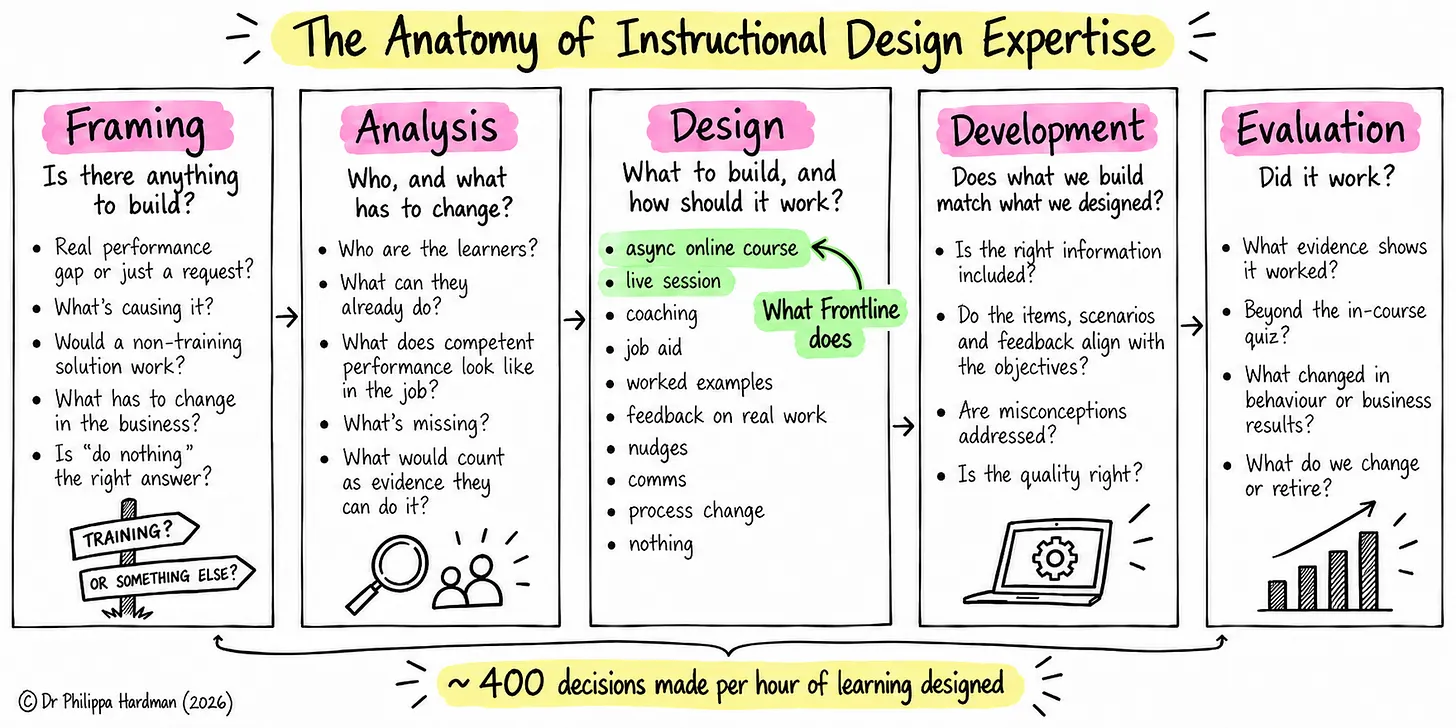
Philippa Hardman reports, "Last week, Articulate launched Frontline, its 'biggest product update in history'. The product is positioned as, 'An AI-native product built for teams who create training outside of L&D'." Hardman also documents the responses from instructional designers, which aren't hard to imagine: first, "a sense of being designed out of our own industry"; second, " closer to betrayal"; and third, "a suspicion that the claim itself doesn't hold," that the tool doesn't really have 'instructional design expertise' built in. Hardman considers the third response at length. "The expertise isn't the output, e.g. the course. It's establishing whether there's a performance problem and what's causing it, deciding whether training can fix it." Then she tests Frontline: "What evidence is there that Frontline encodes the right process and decisions, in the way an expert instructional designer would make them?" There is no diagnosis step, she concludes. The design remains the same even when the goal changes. The assessment doesn't match the objective. Frontline does a very small part of the instructional designer's job - "one subsection of one phase" (illustrated).
Web: [Direct Link] [This Post][Share]
Philosophy of Education as a Global Field
Liz Jackson,
Educational Theory,
2026/09/18
Interesting article (9 page PDF) beginning with the observation that "philosophy of education remains a highly elite, Eurocentric field, like most others" and continues with a look at what it would mean to take a global view of the discipline. Or "maybe philosophy of education should not strive to be global in the sense of being more internationally diverse or representative." Only if we are focused on conceptual analysis, only if we embrace "the transcendentalist delusion: a belief that thought can be separated from its specific, embodied, and geo-historical source," can we think of a 'global' philosophy of education. "There is not just one sense of what it means for philosophy of education to be a global field; diverse orientations to the global invite us to consider different strategies for effective intellectual development, participation, and engagement." Good discussion. See also: Liz Jackson
& Duck-Joo Kwak, Is philosophy of education western?
Web: [Direct Link] [This Post][Share]
Beyond the binary definition of “Stupid” and “Smart” education: towards “Smupid” education?
Boulus Shehata, Ahmed Tlili, Ronghuai Huang, Jon Dron, Aras Bozkurt, Kinshuk, Elvira Popescu,
Smart Learning Environments,
2026/09/18

This article (19 page PDF) analyzes studies of 'smart' and 'stupid' education, concludes there's no single definition (quelle surprise!) and offers an alternative mixed account where 'smart' and 'stupid' can be defined along various axes, for example (as proposed in the paper), adaptive/non-adaptive, beneficial/harmful. It seems like a lot of work for a minimal conclusion, though I suppose it is helpful to be clear that different people define 'smart' differently. Via Jon Dron, who sees something deeper in it: "It is important to remember that technologies as they are enacted are almost always partly intracranial: there are things we have to do, ways we must participate, many of which demand intelligent choices to be made."
Web: [Direct Link] [This Post][Share]
There are many ways to read OLDaily; pick whatever works best for you:
- Read in your web browser on this web page, updated weekdays
- Receive a daily or weekly email newsletter by subscribing here
- Subscribe to the RSS feed using your favourite feed reader
- Follow @OLDaily@mastodon.social on Mastodon or elsewhere in the fediverse
- Follow @OLDaily on Bluesky
- Read OLDaily as a LinkedIn Newsletter
- Integrate the open API using the JSON feed
This newsletter is sent only at the request of subscribers. If you would like to unsubscribe, Click here.
Know a friend who might enjoy this newsletter? Feel free to forward OLDaily to your colleagues. If you received this issue from a friend and would like a free subscription of your own, you can join our mailing list. Click here to subscribe.
Copyright 2026 Stephen Downes Contact: stephen@downes.ca
This work is licensed under a Creative Commons License.