
If you didn't get yesterday's newsletter you can find it here
Proceedings of FediForum, October 2026
FediForum,
2026/10/13

Videos and notes from the FediForum conference I attended last week. Most recommended is Anil Dash's keynote address in which he laid down some truth on app developers hoping to jump on the VC gravy train (sadly there's no transcript). There's also a recording of the presentation on ATmosphere Spaces and a number of live demos, including the IndieBeat radio stream, Acorn Bluesky communities, the FediDeck Tweetdeck alternative for Mastodon and Bluesky, and the AllPeeP community app.
Web: [Direct Link] [This Post][Share]
Philosophy Fumbles the Bag
2026/10/13

Some realistic thinking about the role of AI in philosophy: "With a little human guidance, you can crank out the kind of papers that make up 95% of what we publish in a few hours. Soon (already?), human guidance may not even be necessary. Do I find this depressing? Just the opposite. Sure, I built my career on this skill, honed it for decades, and now a computer can do it in a hundredth of the time. In some ways, it even does better work than I ever could. But this was always a goofy way of making a living. And, in truth, it's always been one of the worst things about the job." It really depends, I think, on what you valued about the work. If it was for being recognized as deep and erudite, then AI isn't for you. But if what matters to you are the questions themselves, AI might be what you need. Imagine, for example, AI solves the problem of consciousness. It's a loss only if your job was based on perpetuating the question. "What do we lose if LLMs kill the journal system? Nothing but some heavy ass chains, and a few weak heuristics for assessing CVs quickly." Via Justin Weinberg, who offers a feeble response defending the continued counting of beans.
Web: [Direct Link] [This Post][Share]
Our minds did not evolve for AI
Benjamin Riley,
Cognitive Resonance,
2026/10/13
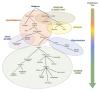
I can accept some version of the evolutionary description of human cognition (illustrated). As a map it probably suffers from some overgeneralization and misattribution, but I wouldn't think it's in any way fundamentally wrong. Human cognition is complex; nobody denies that. Where I disagree with Benjamin Riley is in the characterization of computational thinking, described as 'cognition' in another diagram, and composed of attention, reasoning, decision making, working memory and long-term memory. It's the usual use of the 'mind as computer' metaphor so many cognitive scientists love. But modern AI-based computation doesn't work like that at all. It's complex, so complex that explaining how it works is a major challenge. Is there any reason an AI could not function as described in the illustration? Probably not, though we would ask, why would it? It's the human brain that struggles against evolutionary limitations, not AI.

Web: [Direct Link] [This Post][Share]
The Real Threat Isn’t AI Replacing Teachers. It’s Universities Thinking It Can
Colin Beer,
Col's Weblog,
2026/10/13

Here's the argument: "Skilled teachers do more than deliver information and feedback. They exercise situated professional judgement, recognise learners' changing needs, support intellectual independence and create the social and knowledge relationships through which disciplinary understanding and professional identity develop. AI can augment these activities, but automating instructional functions does not replace teachers' educational role." First of all, I think that overstates what teachers do - people might be assisted in creating relationships, but this is done by the person, not the teacher. And it understates what is very likely to be within the grasp of AI: judgement, recognition, and support. More to the point: I think that in the future we'll skip the 'teaching' step altogether. We'll go from wanting to do something to doing it, with the knowledge and support we need available to us on the fly.
Web: [Direct Link] [This Post][Share]
What is a Learning Technologist for?
David Hopkins,
Education & Leadership,
2026/10/13

David Hopkins asks the question and comes back with a number of different answers, everything from "concentrat(ing) on the structure of a learning experience, working with subject specialists to consider activities, sequencing, engagement and assessment" to "work(ing) more directly with platforms, implementation, staff development and support." I would imagine there are more roles than listed here. "They need to understand accessibility, inclusion, assessment, copyright, data protection and the policies or regulations within which their institution operates. They may need skills in communication, training, project management, evaluation, procurement and organisational change. They must also be able to work with people whose needs, confidence and priorities vary enormously."
Web: [Direct Link] [This Post][Share]
Interpoll
Viktor Konkov,
GitHub,
2026/10/13

There's a lot of interesting thinking going on here, though the implementation is a little but clunky - the design is fine, but scrolling is not smooth and there's a short lag every time you click a link. The site is called Interpoll and the idea is twofold: first, there's no central server at all, everything runs peer-to-peer, and content is replicated as it propagates; and second, "a key lives on your device and signs every action you take. No relay or server can forge a vote in your name." It's based on a "a peer-to-peer database (GunDB). Every connected device holds a copy" (I'm totally not on board with that branding). There are some complaints on Reddit about the use of AI, but on the other hand, the creator is a 14 year old who enjoys coding. Similar projects include Nostr and Scuttlebutt (more).
Web: [Direct Link] [This Post][Share]
Phones impede learning: Evidence from a massive phone-free classroom experiment
Alp Sungu, Pradeep Kumar Choudhury, Andreas Bjerre-Nielsen,
Science,
2026/10/13
I'll just quote Mike Caulfield on this one: "I really don't think Science should publish any articles on education anymore if they think 0.07 is a 'sizable signal' -- I want to be upset but I'm more embarrassed for them. I normally wouldn't even call them out except for some reason we use a publication run by chemists and physicists to determine the education of our children, and it has been doing damage there -- embarrassingly obvious damage -- for the past 20 years."
Web: [Direct Link] [This Post][Share]
The book next to the book: embedding serendipity as pedagogy
Dave Webster,
2026/10/13

I remember once reading everything I could find by Nicholas Rescher in the university library (he was a very prolific writer). He wasn't on any of my course lists, and wasn't recommended to me by anyone; he was just on the same shelf as some theories of truth I had been assigned. I liked his approach, and read his work with enthusiasm. That's the sort of thing being described in this post. We hear about it a lot, and it expresses the common concern that serendipity is being eliminated as we move from the physical to the digital. I disagree. Serendipity is a state of mind, not an environment. I encounter it in the digital world every day, because I take the time to explore the space around whatever I'm looking at. And I make sure my RSS feed contains everything from Satya Nadella writing on 'Super Intelligence' to Colossal covering the Timeless Swiss Masked Tradition of Silvesterchlausen. If you can't find serendipity on the web, you just aren't trying.
Web: [Direct Link] [This Post][Share]
In the world of LLMs, the description is the hyperlink
Mike Caulfield,
2026/10/13

Mike Caulfield channels Ted Nelson and Vannevar Bush in his argument (with a demonstration) that people can (and will?) now search using descriptions with AI producing a set of relevant results. The demo posits rough movie descriptions, like "A low-budget social fable that uses an alien outsider as a lens on an otherwise intact, realistically observed urban community" and the query is sent to Google, which uses its AI to come up with a series of five recommendations. Except - who searches for movies that way? So step two is that you pick a movie you already like, the AI generates these short descriptions, and you click on the one that appeals to you the most. So we're back to the recommender system. The obvious next step is to monetize it and to only show movies offered by your current provider.
Web: [Direct Link] [This Post][Share]
There are many ways to read OLDaily; pick whatever works best for you:
- Read in your web browser on this web page, updated weekdays
- Receive a daily or weekly email newsletter by subscribing here
- Subscribe to the RSS feed using your favourite feed reader
- Follow @OLDaily@mastodon.social on Mastodon or elsewhere in the fediverse
- Follow @OLDaily on Bluesky
- Read OLDaily as a LinkedIn Newsletter
- Integrate the open API using the JSON feed
This newsletter is sent only at the request of subscribers. If you would like to unsubscribe, Click here.
Know a friend who might enjoy this newsletter? Feel free to forward OLDaily to your colleagues. If you received this issue from a friend and would like a free subscription of your own, you can join our mailing list. Click here to subscribe.
Copyright 2026 Stephen Downes Contact: stephen@downes.ca
This work is licensed under a Creative Commons License.