
Student Success (in the Age of AI)
Steve Hargadon,
2026/06/01

Good post though perhaps too long on how we should change how we think about education in the age of AI. Steve Hargadon writes, "What AI destroys is performed compliance: the busywork, the credential that certified obedience, the elaborate game in which students learned to produce the appearance of understanding and call it an education. That was never worth keeping." But what's left? "In the age of artificial intelligence, agency is no longer one path to success among many. It is the only thing left that can actually produce it... it is the one input the new machine cannot supply, cannot fake, cannot simulate, and cannot replace." I think that's partially true; agency depends on, and is intertwined with, human experience. Anyhow, Hargadon continues, "If agency is the whole game, then the only question that matters for education is how a human acquires it. These are described in "the conditions of learning, and they are irreducibly human and relational. They are also, not coincidentally, the one thing the new machine cannot provide because they are not made of information. They are made of relationships."
Web: [Direct Link] [This Post][Share]
What I Learned at NAFSA 2026
Alex Usher,
HESA,
2026/06/01

With no sense of context at all, Alex Usher spends a good part of this post trashing Canada's limited participation in a "higher education fantasyland" NAFSA conference on international education held in Florida (yes, the 'F' stands for 'foreign' - that's part of the context). Representation from Africa was not present - they're not really welcome in the U.S. any more. Canadians (Usher excepted) are less keen on travel to the U.S. these days, for some very good reasons. And the whole concept of international education has changed over the last few years (Canada, for example, has more demand than it can meet, and has scaled back international student numbers a lot recently). But mostly, there's no real desire in Canada to, shall we say, integrate with U.S.-based initiatives these days, educational or otherwise. The only real surprise here is that Usher considers Canada's limited participation to be a problem.
Web: [Direct Link] [This Post][Share]
Shared Ownership, Shared Success: The Power of Consensus
Eric Sheninger,
A Principal's Reflections,
2026/06/01

I think actual consensus is more complex than people realize. This post is a case in point. Eric Sheninger writes that consensus is distinct from principles like unanimity and compromise, which is fair enough, but then writes, "consensus is a cooperative process through which all group members develop and agree to support a decision in the best interest of the entire school." He then switches to the passive sense to add "every viewpoint is considered, and earnest efforts are made to address legitimate institutional concerns." Now to me that reads as (and stay with me here) authoritarian. Someone has decided that 'the best interests of the school' prevail, whatever they are, as opposed to (say) the best interests of students; views are 'considered' and 'earnest efforts' are made by someone, who will actually decide what is done, and ultimately, people are expected to "deep collective commitment" even if the outcome didn't meet their original concerns. Now of course this article does not endorse authoritarianism of any sort; the suggestion is that the process emphasises "a shared leadership framework that activates the collective intelligence of the entire faculty." But to work, the collective intelligence cannot be constrained by prior stipulations, cannot be represented by a single voice, and needs to have the ability to decide that perhaps a single shared perspective on something isn't a desirable outcome.
Web: [Direct Link] [This Post][Share]
In Search of Podcasts
Knotbin,
2026/06/01

This is an interesting article based on comparing podcasts (and by extension, RSS) and the ATmosphere protocol used by Bluesky. "'Wherever you get your podcasts' represents the interoperable utopia of the podcast world," writes Roscoe Rubin-Rottenberg. "How do we bring that magic to the atmosphere?" In short: you can't. A podcast shares one simple thing, a podcast feed. But "on atproto, everything is a record, and each record has its own type. Posts, likes, follows, blocks, lists, profiles, comments, videos, and anything you can think of has its own defined schema, denoted by a $type." This gets even more complex when we start reasoning about things like follows and blocks. I find this article to be a good foil to contrast with my own approach in CList, which is a lot simpler.
Web: [Direct Link] [This Post][Share]

These are protocols I'm looking at as I develop DID-based interactions in CList. "DIDComm protocols enable trusted interactions between parties. These support activities like secure chat, verifiable credential exchange, buying and selling, scheduling, escrow, bidding, ticketing, and so forth. If not already in use, protocols can be designed for any use case." I have no interest in most of the items listed, but there are many more practical protocols presented. See also: DIDComm Book.
Web: [Direct Link] [This Post][Share]
The Contradiction at the Heart of AI Disclosure: Judith Butler and the Subject of Accountability
Owen Matson,
LinkedIn,
2026/06/01

I hate linking to LinkedIn, even though it appears people can read this without a login, because access is so tenuous. I don't know why people don't do their writing on a proper blog. Anyhow. I wanted to link to this item, which reviews Judith Butler's Giving an Account of Oneself (sadly behind a paywall) because it makes an important point. For Butler, "Many contemporary AI-disclosure practices seek to identify and isolate machine participation as though intellectual activity ordinarily originates within a self-contained individual whose boundaries can be clearly identified and preserved. Increasingly complex forms of human-AI interaction disrupt those assumptions." We don't develop our thoughts and ideas in isolation, usually: we develop them through interaction with other people, the world, and these days, computers. For Butler, "subjects are required to make themselves intelligible through normative frameworks incapable of accounting for the experiences they are being asked to disclose."
Web: [Direct Link] [This Post][Share]
The Pope on Defederation
Laurens Hof,
connectedplaces.online,
2026/06/01

The Pope's Magnifica Humanitas encyclical is viewed as a treatise on AI, writes Laurens Hof , but "this week, the Catholic Church also wrote one of the better diagnoses of why decentralised social networks keep struggling." We might call this the 'framework of subsidiarity and solidarity'. By 'subsidiarity', we refer to a basic principle of decentralization, which pushes power don the hierarchy to the smallest unit where it makes sense (in the Papal view, that would be the family; in the libertarian view, that would be the individual). But the other part of this is solidarity (which libertarians pretend doesn't exist). "Subsidiarity without solidarity is fragmentation: a thousand instances each guarding their own place, with no shared obligation or collaboration, with no place to maintain the commons that is the network itself." True, but incomplete. Solidarity is about more than just governance. It's about how we communicate, how we interact, and how as a community we develop ideas and values and more.
Web: [Direct Link] [This Post][Share]
A human centered model for discussing AI in assessment
Dave Cormier,
Dave's Educational Blog,
2026/06/01
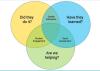
This post starts off with comments about changes to what we control in assessment but quickly turns to the subject of what, exactly, we are assessing. The result is a Venn diagram with three categories, expressed as questions: Did they (students) do it? Have they learning? Are we helping? The first is where most discussions of AI and assessment end, but it's actually the least important of the questions (and, frankly, if they've learned what they should be learning, who cares whether they 'did it', whatever it is?). The third talks to the utility of our intervention, whether related to the assessment or not. Though as Dave Cormier says, "good assessment is a combination of something that is designed to serve your learning goals AND something that helps the student learn more after they've done that assessment."
Web: [Direct Link] [This Post][Share]
Mastodon - How To Make Posts
Eugen Rochko,
YouTube,
2026/06/01

It's hard to believe you could create a 28 minute video on how to make a Mastodon post but founder Eugen Rochko (aka Gargron) has managed to do it. "Posting on Mastodon is easy and intuitive at its core, however, there are many features that are unique to Mastodon and may be less obvious. This tutorial goes every single feature in Mastodon's composer interface."
Web: [Direct Link] [This Post][Share]
There are many ways to read OLDaily; pick whatever works best for you:
- Read in your web browser on this web page, updated weekdays
- Receive a daily or weekly email newsletter by subscribing here
- Subscribe to the RSS feed using your favourite feed reader
- Follow @OLDaily@mastodon.social on Mastodon or elsewhere in the fediverse
- Follow @OLDaily on Bluesky
- Read OLDaily as a LinkedIn Newsletter
- Integrate the open API using the JSON feed
This newsletter is sent only at the request of subscribers. If you would like to unsubscribe, Click here.
Know a friend who might enjoy this newsletter? Feel free to forward OLDaily to your colleagues. If you received this issue from a friend and would like a free subscription of your own, you can join our mailing list. Click here to subscribe.
Copyright 2026 Stephen Downes Contact: stephen@downes.ca
This work is licensed under a Creative Commons License.