There Is No 'Hard Problem Of Consciousness'
Carlo Rovelli,
NOEMA,
2026/05/08

You can read my essay on consciousness or you can read this article - the point being made is exactly the same (and certainly not unique to either of us). "Experience is not over and above the processes that happen in the brain, as Chalmers assumed upfront. The dualism between a first-person description of experience and a third-person (or scientific) account of the same is a normal perspectival difference: the same brain phenomenon as experienced by that same brain itself, or by another. Experience for both - not evidence of two different kinds of reality."
Web: [Direct Link] [This Post][Share]
W Social uncovered: the reality behind the hype
Elena Rossini,
2026/05/08

The tagline says it well: "this is "an article dispelling myths about W Social, the new European platform that aims to rival X: it is a fork of Bluesky that shares many similarities with Eurosky and requires government ID to sign up." Leaving aside internal European politics, it's worth noting that W Social was launched at Davos with a lot of fanfare (while Eurosky, the European Bluesky instance, set up a side event, and Mastodon, also based in Europe, went unmentioned). There's a lot more in the article, but as Elena Rossini says, "W Social is set to launch tomorrow May 9th on Europe Day. As it happened when it was first announced in January, it is likely to receive a lot of uncritical, superficial press coverage. Please exercise critical thinking and try to look at the reality behind its hype." (p.s. I'm stealing the 'written by a human' image from this page :) ).

Web: [Direct Link] [This Post][Share]
FediProfile — The Decentralized Link-in-Bio
Maho Pacheco,
2026/05/08
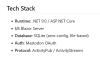
This is an interesting project (paradoxically written in Razor) that presents itself as an "open-source, federated alternative to Linktree," or more specifically, a "decentralized link-in-bio that connects to the Fediverse (where you can) share links, collect badges, and own your online presence (with) no corporation in the middle." Code on GitHub. Via Johanna Botari.
Web: [Direct Link] [This Post][Share]
The Boring Internet
https://indieweb.social/@tg,
Terry Godier,
2026/05/08

"The internet is not dying," writes Terry Godier, "A commercial veneer glued on top of it is dying." I'm not a fan of the muted text in dark mode and the scroll reveal presentation, but the message in my view is sound. Godier presents a three-layered internet: platforms, which are the commercial veneer; services like GitHub and Cloudflare, which can be large and influential but are not actually necessary; and finally, the actual set of protocol-based services, things like Icecast (shoutout to Soma.fm), RSS (I subscribed), HTML (you're soaking in it) and finger. Boring: "too useful to disappear, too uncool to hype, too federated to acquire, and too awkward to turn cleanly into a platform."
Web: [Direct Link] [This Post][Share]
Expanding OER with GenAI
Lance Eaton, Larry Davis,
EDUCAUSE,
2026/05/08

This article blends the ideas of generative AI and open educational resources and the results are about what is to be expected. The authors begin with licensing concerns, asserting that "educators must still assign an open license if they intend for others to use, share, or adapt that content freely," though they are aware that "a creator might not be able to assign a license because the work is not copyrightable." They offer a 'GenAI-OER Adoption Framework' based around the idea of adoption, adaptation and building. They should have included 'share' somewhere in there. The rest is boilerplate advice: start slow, share what you've learned, "align practice with the core values of openness, equity, agency, and care."
Web: [Direct Link] [This Post][Share]
Hackers steal students’ data during breach at education tech giant Instructure
Lorenzo Franceschi-Bicchierai,
TechCrunch,
2026/05/08
This week's big story is a confirmed data breach at Instructure affecting students' private information. As TechCrunch and others report, the hacking group ShinyHunters claimed responsibility. Hacks started Tuesday and continued through the week. The company is reported to be held for ransom by the attackers. Ian Linkletter comments, "Instructure has been bragging about their data hoard to investors for years, and now it's been stolen." In all, "the hackers claimed to have stolen data from almost 9,000 schools around the world, with the stolen files allegedly containing information on 231 million people." Here's more.
Web: [Direct Link] [This Post][Share]
Artificial intelligence as a site of global educational governance: the case of UNESCO
Eleni Christodoulou, Michalinos Zembylas,
Journal of Education Policy,
2026/05/08
This paper is a critical reflection of UNESCO's policy role in the governance of AI in education (AIED). It's a jigsaw puzzle of a paper, consisting less of a logical flow and more as a set of pieces that fit together to form a perspective. Two pieces are UNESCO's own view of its own role in AIED: on the one hand, as a champion of human rights and justice, and on the other hand, anticipating and sometimes facilitating disruptive technologies. Four pieces are different ways of viewing international organizations (IO): "global governance theory, Foucauldian governmentality, AI ethics critiques, and critical education policy." Three additional pieces are functions regarding AIED: "observatory, capacity development, and normative frameworks." Then there are pieces describing what UNESCO does: "production of policy guidance, teacher support tools and mapping exercises focused on the incorporation of AI into national curricula." The picture that emerges is a "structural decoupling between UNESCO's rhetorical commitments and its policy implementation in the governance of AIED." UNESCO should be supporting development and human rights, but may instead see AIED as an opportunity to enhance its governance function. Image: UNESCO IITE.
Web: [Direct Link] [This Post][Share]
There are many ways to read OLDaily; pick whatever works best for you:
- Read in your web browser on this web page, updated weekdays
- Receive a daily or weekly email newsletter by subscribing here
- Subscribe to the RSS feed using your favourite feed reader
- Follow @OLDaily@mastodon.social on Mastodon or elsewhere in the fediverse
- Follow @OLDaily on Bluesky
- Read OLDaily as a LinkedIn Newsletter
- Integrate the open API using the JSON feed
This newsletter is sent only at the request of subscribers. If you would like to unsubscribe, Click here.
Know a friend who might enjoy this newsletter? Feel free to forward OLDaily to your colleagues. If you received this issue from a friend and would like a free subscription of your own, you can join our mailing list. Click here to subscribe.
Copyright 2026 Stephen Downes Contact: stephen@downes.ca
This work is licensed under a Creative Commons License.