Trade-offs and Menus
Alex Usher,
HESA,
Apr 07, 2026
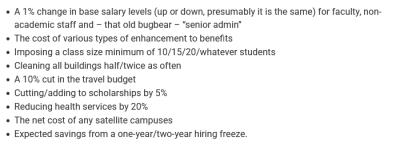
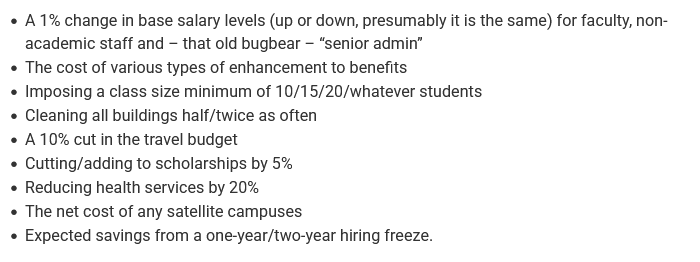
So much of what pretends to be good economics is really just an exercise in framing (or its political equivalent, defining the Overton window). That's what Alex Usher is up to with his articles on trade-offs, both yesterday (in which he asserts the university "exists to provide a space where individual disciplines can do sell their products") and today when he proposes creating "a menu of what everything costs" so we can understand the trade-offs. Now, actual good economics would understand that the university is a complex system, and that the trade-offs aren't really tradeoffs. Any change in one line item has a ripple effect across all the other line items, which create their own ripple effects in turn. Depicting university budgets as trade-offs is a bad strategy. So why do it? Because it allows you to create a list of the sort of changes that will be allowed. Usher's list consists entirely of cuts to staffing and support services, because those are the only places allowed to be considered; a similar list of revenues would include things like tuition and fee hikes, again because nothing else is on the table. The politics here is to get faculty and staff arguing among themselves within the confines of these options, without ever touching on an overall strategy that would make a real difference.
Today: Total: [] [Share]