
Cloud-based vs self-hosted messaging: Which do you prefer?
Kathrin,
OEGlobal Connect,
2026/06/18

This is such a great question I'm going to post it here: "Do you prefer cloud-based platforms like Slack, Microsoft Teams, or Google Chat, or do you use a self-hosted alternative? like Apphitect, Rocketchat, or MirrorFly." I would imagine the vast majority of people use the cloud-based solutions, and may not have even heard of the hosted solutions. Obviously, the two modes fit different use cases. I would ideally lean toward self-hosted, but have in fact always used cloud-hosted. So I need to think a lot about what this question means to the people who are answering it.
Web: [Direct Link] [This Post][Share]
Writing Was Never a Test of Who Could Think.
Abi Awomosu,
How Not to Use AI,
2026/06/18

There are some nuggets of goodness in this article that is far longer than it needs to be. The first is right near the beginning: "AI is not a tool. It's actually a medium." I like that recasting; AI can be used to create, express and distribute our ideas and thoughts even if we struggle with an inflexible and linear medium like language. But what does creating in AI look like? There are some good ideas: an emphasis on both speaking and listening, the idea of 'flaw-speak', which is the deliberate degrading of one's speech to avoid being perceived as AI, 'Algo-speak', "where the reader we were writing for stopped being a person and became a system," and almost exactly half way through, a list of things people "actually do" when using AI in writing (it's more than just cut and paste). The author warns at the beginning that the article is AI-assisted; I thought it would be really funny if, near the end, the author recanted, and said it was all human after all. Alas, that never happened.
Web: [Direct Link] [This Post][Share]
The Fable of AI in Education
Marc Watkins,
Rhetorica,
2026/06/18
The term 'tokenomics' has already been defined to apply to blockchain, but I'm going to apply it in a new context, to describe the new and emerging science of minimizing the use of tokens while maximizing AI utility. Tokenomics will be a hot topic of discussion on university campuses because, as Marc Watkins notes in this article, there is no realistic path forward to providing all students with access to advanced AI. "That alone," he writes, "should make even the most staunch AI critic pause and ask who, aside from the already affluent and extremely resourced institutions, will have such access and what this means for opportunities for all students." (p.s. I am not on board with the new uses and meanings for the word 'jagged').
Web: [Direct Link] [This Post][Share]
The Easier Technology Gets, the More Challenge Matters
George Couros,
2026/06/18
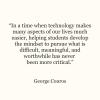
The core message here, which draws from a Jonathan Haidt TED talk, is that "In a time when technology makes many aspects of our lives much easier, helping students develop the mindset to pursue what is difficult, meaningful, and worthwhile has never been more critical." I find that a bit ironic, because in the world of easy and hard, TED talks are definitely on the side of easy. But I agree with the need to do hard things - that is, for example, why I decided to bikepack, despite being the wrong age and the wrong body shape for anything like that. But - importantly - some things (like, say, buying food, or paying rent) should be easy, and some things are better when they are hard (like say, things that are meaningful, whatever that means). The easy thing is to say "do hard things". The hard thing is to say which things should be hard to do.
Web: [Direct Link] [This Post][Share]
The Current State of Play: AI in Higher Education and the Road Ahead
Tanya Gamby, David Kil, Rachel Koblic, Paul LeBlanc, Mihnea Moldoveanu, George Siemens,
EDUCAUSE Review,
2026/06/18

I mostly agree with what's expressed in this article but I disagree with the tenor, which has the university still providing and the student still consuming. As in this, for example: "The convergence of learning analytics, AI advising systems, early alert platforms, and wellness monitoring has created something genuinely new... the data to support learners holistically is increasingly available. What most institutions lack is the architecture to connect it, the governance to use it responsibly, and the human capacity to act on what it reveals." I'm not seeing the university recognize its need to transform from authority to enabler, which is what it will need to do when expertise is widely distributed.
Web: [Direct Link] [This Post][Share]
There are many ways to read OLDaily; pick whatever works best for you:
- Read in your web browser on this web page, updated weekdays
- Receive a daily or weekly email newsletter by subscribing here
- Subscribe to the RSS feed using your favourite feed reader
- Follow @OLDaily@mastodon.social on Mastodon or elsewhere in the fediverse
- Follow @OLDaily on Bluesky
- Read OLDaily as a LinkedIn Newsletter
- Integrate the open API using the JSON feed
This newsletter is sent only at the request of subscribers. If you would like to unsubscribe, Click here.
Know a friend who might enjoy this newsletter? Feel free to forward OLDaily to your colleagues. If you received this issue from a friend and would like a free subscription of your own, you can join our mailing list. Click here to subscribe.
Copyright 2026 Stephen Downes Contact: stephen@downes.ca
This work is licensed under a Creative Commons License.