"Ghiblified by AI": Viral AI-generated image trend in press narratives
Paulina Rutecka, Karina Cicha,
First Monday,
2025/09/18
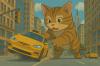
In April of this year people began using GPT-4o to transform photos into graphic images inspired by Studio Ghibli. It became an instant sensation known as Ghiblification. Though controversial, this sort of thing is exactly what I love about the web: the capacity of people to take trillions of dollars worth of technology and use it to post cat pictures. Anyhow, this article analyzes the trend as it was covered in media, and arrives at this conclusion (which probably defines our times better than anything else): "The analysis of news articles covering the Ghibli trend revealed a clear dichotomy in media orientation, oscillating between clickbait-driven narratives and ethically focused reporting... this study underscores how journalistic coverage can either contribute to the superficiality of viral trends or foster a more informed and ethically aware public discourse." The same, of course, of education.
Web: [Direct Link] [This Post][Share]
2 + 2 = oppression
Joanne Jacobs,
2025/09/18

Joanne Jacobs relays this accusation that Woke is alive and well in math education from Erika Sanzi of Defending Education (the article is in the Washington Times, but Jacobs doesn't mention that). We're supposed to think this is a bad thing, but I'm personally relieved to see that people are still thinking about issues of agency and identity in education, even as people like Jacobs and Sanzi try literally to oppress it. Sanzi begins by dumping on the National Council of Teachers of Mathematics, which since 1920 has been publishing academic journals, math standards, and other resources. She picks three of the 622 concurrent sessions to critize for existing: Iron Sharpens Iron: Black Womxn in Mathematics Education (BWXME) Speak; Black Feminist Mathematics Pedagogies: Implications for Teaching from a Curricular Analysis (which btw looks really solid); and Reflecting on My Whiteness: Unpacking the Barriers towards Transformative Mathematics Teaching. The image used to illustrate the Jacobs post is entirely fake, fabricated by the art department of the NY Post. Note that while I rarely link to this sort of coverage in OLDaily, for good reason, I keep an eye on it, because it lays bare the means and motivations for a lot of 'education reform', including a lot of educational technology. Image via Lindsey Jensen.
Web: [Direct Link] [This Post][Share]
Social Media and the Mental Health of Children and Adolescents
German National Academy of Sciences,
2025/09/18
This paper (70 page PDF) recommends "the EUDI Wallet, to be introduced in all EU Member States by 2026, be designed in Germany so that it is available to all citizens aged 16 and over and enables data minimal age verification." I imagine EUDI wallets designed elsewhere might have the same capacity, but that's not the point. The question is whether a digital wallet can be used to (anonymously) verify age. I think it can, in the main. The key incentive here is to ensure adults do not share their wallets with children, and if wallets are tied to sensitive information (like, say, bank account access) then that incentive exists. Then the wallet need only attest (a) this is a valid EUDI wallet (which can be confirmed by a third party) and (b) the bearer is over 16 years of age. Via IDW. Related: a French Commission recommends banning social media for children, reports the BBC. "We must force TikTok to rethink its model," says the commission, which heard testimony from teenagers and the families of young victims.
Web: [Direct Link] [This Post][Share]
The Handbook of Experiential Pedagogies
Kari Grain, et al.,
UBC Centre for Community Engaged Learning,
2025/09/18
This document (42 page PDF) shows how participants can "engage in a variety of pedagogies and also discuss how we experienced them, how we might take into account issues of accessibility, equity, and decolonization in our approach to the pedagogies." If you're looking for an alternative to digital pedagogies, this book is it. I found it while following a link sent by Alan Levine to (ironically) Digital Learning for Innovative Teaching from Vancouver Community College. It desceibes a method based on exploration, practice and application; I was following links to practice building learning communities. There's a ton of other things to explore here, and what I really like is that you don't have to be enrolled in the college to use and apply the resources. Stuff like this, if well marketed and supported, is what keeps learning institutions relevant to the community as a whole.
Web: [Direct Link] [This Post][Share]
Introducing Coursera Skill Tracks
Patrick Supanc,
Coursera Blog,
2025/09/18
Coursera has introduced something called 'skill tracks', "a tailored, data-backed learning solution to help functional teams develop critical and verified skills." To the rest of us these resemble learning programs. You can see a demo of the interface here. There are four major areas, with roles defined in each. A 'career graph' defines the skills needed for each role. The result overall resembles the long-envisioned model of learning objects, though of course none of these resources is open access.
Web: [Direct Link] [This Post][Share]
There are many ways to read OLDaily; pick whatever works best for you:
- Read in your web browser on this web page, updated weekdays
- Receive a daily or weekly email newsletter by subscribing here
- Subscribe to the RSS feed using your favourite feed reader
- Follow @OLDaily@mastodon.social on Mastodon or elsewhere in the fediverse
- Follow @OLDaily on Bluesky
- Read OLDaily as a LinkedIn Newsletter
- Integrate the open API using the JSON feed
This newsletter is sent only at the request of subscribers. If you would like to unsubscribe, Click here.
Know a friend who might enjoy this newsletter? Feel free to forward OLDaily to your colleagues. If you received this issue from a friend and would like a free subscription of your own, you can join our mailing list. Click here to subscribe.
Copyright 2025 Stephen Downes Contact: stephen@downes.ca
This work is licensed under a Creative Commons License.