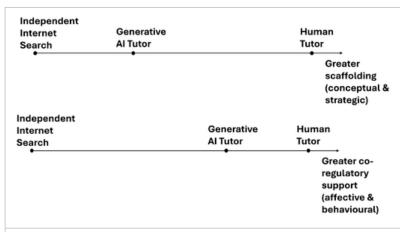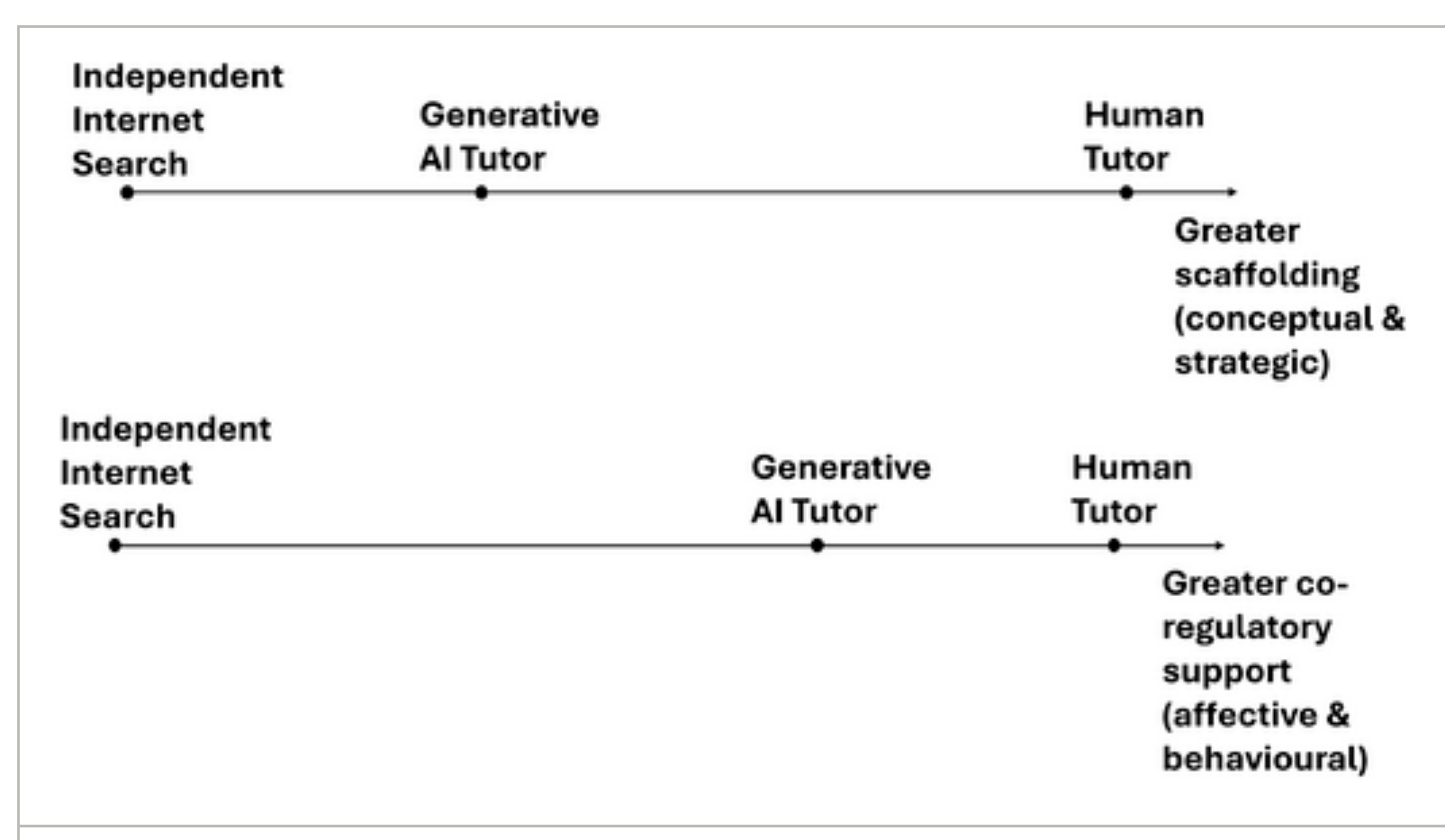
The abstract tells the story in this article, though the interesting bits are in the background and in the methods section, as the focus is on the effort students undertake under different modes of tutoring. "Students aged 16–18 at an English sixth-form college worked on two sections of challenging mathematics questions with one of three forms of support: one-to-one human tutoring, a GenAI tutor or unguided internet search." They reported an easier time with the human tutoring. Perhaps that's because human tutors can do things like motivate and challenge better than computers (aka, the 'other' scaffolding) or perhaps it's because the machines offer a different kind of support. "The study provides empirical grounding for theoretical accounts that position a GenAI tutor as a qualitatively different kind of learning 'other': one that may sustain engagement and shape regulation without reproducing the full scaffolding and co-regulatory capacities of a human tutor."
Today: Total: [] [Share]