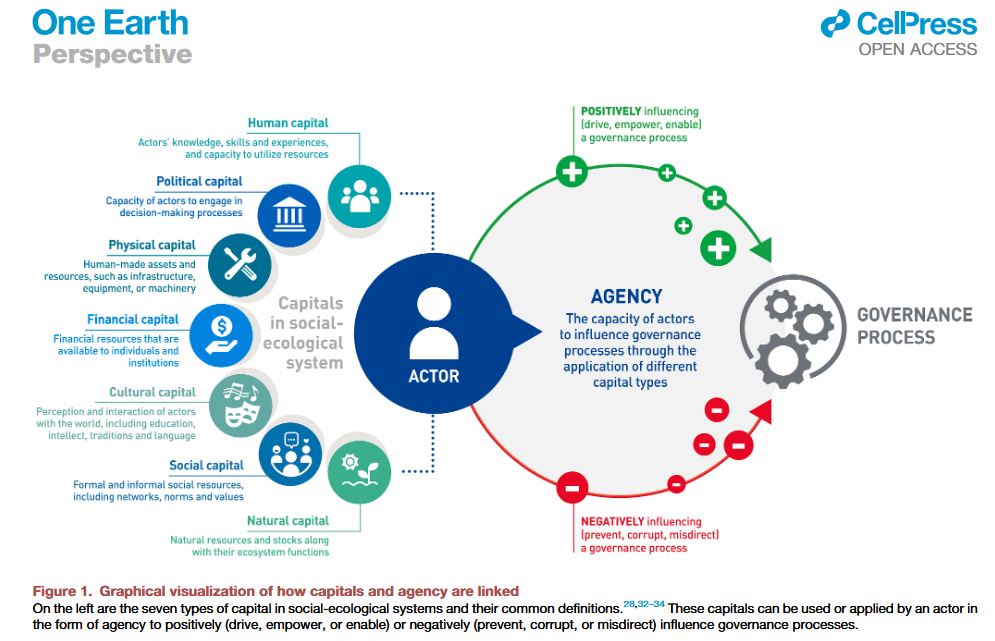
I have talked in the past about the idea that social (or public) knowledge results from a network process. This article (13 page PDF) is a version of a similar idea, but with some significant differences. The context is agency in global sustainability actions, for example, forest management in Germany, or water resources in Spain. The authors describe five forms of agency: "allocating human resources, enacting political relevance, influencing financial flows, providing physical goods and assets, and steering social-ecological discourse." These in turn are represented as forms of capital: human capital, political capital, physical capital, etc. These flow through a network structure to influence the governance process. There are of course significant problems with this model (notwithstanding that it may be empirically accurate). Capital of any sort is not distributed equitably, and some forms of capital are also counter to individual sovereignty. It's a process that bypasses and therefore may subvert democracy. The issue (in my view) is the focus of this network on single points of control - the 'management' of resources.
Today: Total: [] [Share]