Humans and Machines Learn Differently
Filip Ilievski, Barbara Hammer, et al.,
IDW,
Sept 15, 2025
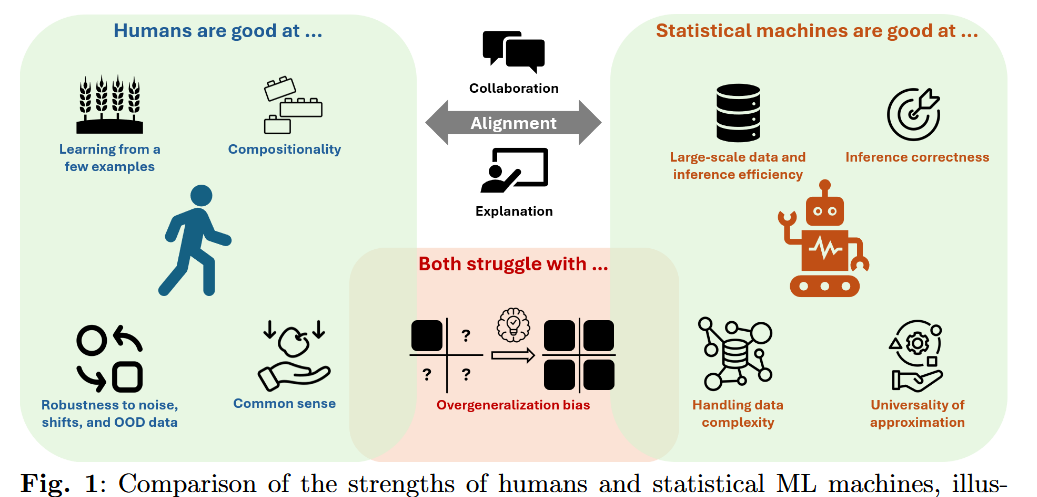
I have often argued that humans and artificial neural networks learn in more or less the same way. The paper referenced here, Aligning Generalisation Between Humans and Machines, argues for the exact opposite conclusion, going so far as to say "a critical challenge of human-AI teaming is reconciling the fundamentally different reasoning paradigms of humans and AI, such as human causal models and AI's deep learning associations." The paper deserves a deep read, if only to identify its flaws. Much of its argumentation is based on a critique of traditional machine learning (for example, referring to the no-free-lunch theorem from 1997). When looking at more recent generative AI, the argument turns from "it can't" to "we don't know how it does it". The paper also makes statements about human learning that are questionable (for example, "a major reason why humans can learn from little data and seemingly generalise beyond the observed distribution is that, through evolution, experience, or both, they have access to strong common sense priors at multiple hierarchical levels," which is academic-speak for "we just know". The paper is published behind a paywall in Nature, but here's the ArXiv version (37 page PDF) from a few months ago.
Today: Total: [] [Share]