
How stronger meta-skills will prepare teams for an AI age of continual learning
Phanish Puranam,
World Economic Forum,
2026/08/06

According to this article, " instead of only asking whether employees have the right skills for the tasks on hand, leaders should ponder how fast - and how well - they can acquire the skills they will need next." These skills - here called 'meta-skills' (but also known as 'soft skills' or 'durable skills') break down into two major categories: critical thinking skills, and social skills (I'm sure there's an interesting story to be found detailing how critical thinking and social skills lead to better learning). According to the article, meta-skills can be assessed via three major indicators: "people with strong meta-skills acquire new skills faster"; they "show up when people apply principles learned in one context to structurally similar but unfamiliar problems": and "meta-skills are visible in how people work." And people can learn them. "Higher order thinking, metacognitive regulation, analogical reasoning and social coordination all improve with structured practice, feedback and reasonably demanding environments."
Web: [Direct Link] [This Post][Share]
ASR In Literacy - What Is It Good For?
Owen Henkel, et al.,
The Learning Agency,
2026/08/06

This article raises some interesting questions about early language learning (ELL) and AI. Specifically, it makes the point that while AI is already quite good for some things (such as speech to word transcription) it needs specialized training for others, such as low-stakes oral reading fluency, and absolutely flounders at others, such as phoneme-level assessment. The model needs "a separate step that compares the recording with the expected sounds." And "Improvements on this narrower task also may not translate into better general transcription." So what does this tell us about phonics as a thing that is learned? Maybe (and I'm speculating here) we learn how words are pronounced first, and parts of words later. The pronunciation of 'cat' and transcription to the letters c-a-t happen as a single step, and are not composed of separate steps (pronunciation of 'k', pronunciation of 'at', transcription to correct letters). Something to think about.
Web: [Direct Link] [This Post][Share]
Designing the AI-Integrated Classroom: A Triadic Learning Ecosystem
Matthew Brophy,
EDUCAUSE Review,
2026/08/06
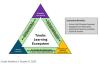
This article describes a Triadic Learning Ecosystem (TLE) that "offers an architecture of that near future, connecting teachers, students, and AI-enabled tools in a collaborative model of learning." The three elements are students (as peer groups), the teacher (as conductor), and pedagogical AI assistant (PAIA) (as scaled support). "Teachers are elevated from content-communicator to classroom conductor. They encourage, challenge, intervene, motivate, and lead." Interesting word choice, 'elevated'. "The students are not passive recipients of information but active builders of it. In small peer groups, they produce, debate, and explain to one another." There's a five phase model that describes class sequencing: co-design, student exploration and creation, PAIA simulation, real-time feedback loop, reflection and synthesis. There's also a (very simple) technology mapping to the framework. There's some good thinking here, but I think it's far too rigid a structure.
Web: [Direct Link] [This Post][Share]
The Professional Toolkit
Tim Klapdor,
Heart Soul Machine,
2026/08/06

A professional can, as Tim Klapdor says, pick up their tools, find a new chair, and keep going. "The skill is his. The relationship with his clients is his. The craft he's spent years developing is entirely portable." Why isn't that the same with university professors? Klapdor explains this by saying each university is a unique machine, but I don't think that's it. True, "the academic, at their best, owns a body of work and the reputation that comes with it." But they don't own their own client list (and don't have the marketing reach to generate one), and they don't own the credential that they, uniquely, can confer.
Web: [Direct Link] [This Post][Share]
Design The Meeting
Corey Ford,
Point C,
2026/08/06
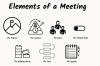
There's so much talk about in-person for the sake of in-person, and then our actual in-person interactions (whether online or in-person) are so badly managed. This article seeks to correct that by focusing on designed meetings, where the purpose, roles, flows and outcomes are determined (so far as possible) to maximize and respect people's time. I appreciate that. Now this article is focused on leadership in a corporate mode, but of course if we elide the business elements (i.e., expenses, value, leverage, etc.) we get a good model for in-person interactions in general, which can inform what we're doing when we collaborate and learn together. Via Ben Werdmuller.
Web: [Direct Link] [This Post][Share]
There are many ways to read OLDaily; pick whatever works best for you:
- Read in your web browser on this web page, updated weekdays
- Receive a daily or weekly email newsletter by subscribing here
- Subscribe to the RSS feed using your favourite feed reader
- Follow @OLDaily@mastodon.social on Mastodon or elsewhere in the fediverse
- Follow @OLDaily on Bluesky
- Read OLDaily as a LinkedIn Newsletter
- Integrate the open API using the JSON feed
This newsletter is sent only at the request of subscribers. If you would like to unsubscribe, Click here.
Know a friend who might enjoy this newsletter? Feel free to forward OLDaily to your colleagues. If you received this issue from a friend and would like a free subscription of your own, you can join our mailing list. Click here to subscribe.
Copyright 2026 Stephen Downes Contact: stephen@downes.ca
This work is licensed under a Creative Commons License.