
Why RSS matters
Ben Werdmuller,
2025/12/09

In 1998 or so my website was RSS feed number 31. That's the number it was assigned on the Netscape Netcenter, at the time the only platform for reading RSS feeds, where it sat alongside feeds for things like Wired and Dave Winer. RSS - also known as 'Rich Site Summary' or 'Really Simple Syndication' has been my go-to ever since. I use it every day, it's the source of a lot of what you see in this newsletter, and of course I use it to distribute these posts, my articles, and even my talks as a podcast. So I'm pretty supportive of what Ben Werdmuller is saying here as he makes the pitch for continued community support for what is essentially a core piece of internet infrastructure.
Web: [Direct Link] [This Post][Share]
The Resonant Computing Manifesto
Maggie Appleton, et al.,
2025/12/09

This manifesto is based on what the authors call 'resonance'. "It's the experience of encountering something that speaks to our deeper values. It's a spark of recognition, a sense that we're being invited to lean in, to participate. Unlike the digital junk food of the day, the more we engage with what resonates, the more we're left feeling nourished, grateful, alive." The manifesto argues for software that resonates, and specifically, software that is (quoted):
- Private: people must serve as primary stewards of their own context.
- Dedicated: Software should work exclusively for you.
- Plural: No single entity should control the digital spaces we inhabit.
- Adaptable: Software should be open-ended.
- Prosocial: Technology should enable connection and coordination.
I'm left wondering whether these principles are each necessary and whether collectively they are sufficient. Maybe it's an answer to the question from yesterday: "if your software doesn't resonate, then you are the product?"
Web: [Direct Link] [This Post][Share]
Twitter.new
2025/12/09

This organization is filing to have the Twitter trademark and logo revoked with the intention of reviving Twitter. You can apply for your (old?) username here. Though one wonders. As Mike Masnick says, "I'm honestly perplexed at to who would try to start from scratch to build a centralized Twitter clone in this day and age, rather than building on an existing open protocol." Though maybe the new Twitter won't be exactly like the old Twitter?
Web: [Direct Link] [This Post][Share]
Fake Education Might Be the Best Teacher
Tim Dasey,
Sweet GrAIpes,
2025/12/09
I think there's an interesting proposition in this paper, though implementation may be daunting and expensive and come with a surprise result. Here's the proposition: "Education desperately needs what other complex fields have - a way to safely explore 'what if' scenarios at every level of the system. We need simulations." Well, OK, but what would that take? "You need knowledge at more fundamental levels - basic patterns of human motivation, learning, and behavior that hold across different contexts." The surprise result? A simulation equipped with all this knowledge would be better prepared than most teachers. My observation is this: why, then, would we leave the job of teaching to the teachers? If the autopilot can fly the plane better than the human, put it on autopilot.
Web: [Direct Link] [This Post][Share]
Towards Critical Artificial Intelligence Literacies
Olivia Guest, Marcela Suarez, Iris van Rooij,
Zenodo,
2025/12/09
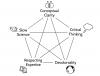
The authors present (12 page PDF) a selection of Critical Artificial Intelligence Literacies (CAIL) across research and education: "conceptual clarity, critical thinking, decoloniality, respecting expertise, and slow science." They derive from an overall objective "that rejects dominant frames presented by the technology industry, by naive computationalism, and by dehumanising ideologies." I think this is a classic case of addressing the symptoms rather than the problem; one could equally well construct a set of CAIL based on gender equality, peace, ecological thinking, fairness and global equity.
Web: [Direct Link] [This Post][Share]
Comment
Daniel Kahneman,
National Bureau of Economic Research,
2025/12/09
This is from 2019 but Ethan Mollock posted it today and it's still true. "Most of the errors that people make are better viewed as random noise, and there is an awful lot of it." Also, "Yann LeCun said yesterday that humans would always prefer emotional contact with other humans. That strikes me as probably wrong." To wrap up, "We are narrow thinkers, we are noisy thinkers, and it is very easy to improve upon us." The evidence for all this is overwhelming in my view, and while I know people don't want to hear it, I see their reticence as just further evidence of the truth of these statements. 4 page PDF.
Web: [Direct Link] [This Post][Share]
There are many ways to read OLDaily; pick whatever works best for you:
- Read in your web browser on this web page, updated weekdays
- Receive a daily or weekly email newsletter by subscribing here
- Subscribe to the RSS feed using your favourite feed reader
- Follow @OLDaily@mastodon.social on Mastodon or elsewhere in the fediverse
- Follow @OLDaily on Bluesky
- Read OLDaily as a LinkedIn Newsletter
- Integrate the open API using the JSON feed
This newsletter is sent only at the request of subscribers. If you would like to unsubscribe, Click here.
Know a friend who might enjoy this newsletter? Feel free to forward OLDaily to your colleagues. If you received this issue from a friend and would like a free subscription of your own, you can join our mailing list. Click here to subscribe.
Copyright 2025 Stephen Downes Contact: stephen@downes.ca
This work is licensed under a Creative Commons License.