
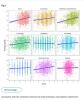
This article reports on a study examining "how secondary students report studying, and the associations these choices have with students' beliefs in their own abilities." The URL for the original study in the article is incorrect, but you can find it here (21 page PDF). I was originally going to complain about the authors inventing a new protocol, which they do, but there's much more to chew on. I was going to complain about "yet another study measuring X's perception of Y" but the study at least finds an association between perception and outcome, which is good, while also casting doubt on the whole 'mindset causes outcomes' argument, which is also good. That's the main focus of the article. But the original study contains an extra treat: the authors seek to find an association between "behaviors supported by cognitive science," such as explained by cognitive load theory and the like, and found it "could explain 9% of school achievement variance," a number that might be further reduced by some other correlations.
Today: Total: Megan Sumeracki, The Learning Scientists, 2026/06/11 [Direct Link]Please select a newsletter and enter your email to subscribe.

Stephen Downes spent 25 years as an expert researcher at the National Research Council of Canada, specializing in new instructional media and personal learning technology. With degrees in Philosophy and a background in journalism and media, he is one of the originators of the first Massive Open Online Course, has published frequently about online and networked learning, and is the author of the widely read e-learning newsletter OLDaily. He is a popular keynote speaker and has presented at conferences around the world. [More]
Support OLDaily
OLDaily has been free and open to all readers since 2001. It is a valuable and widely-used resource for educators, researchers, and learners worldwide. Please consider a monthly contribution to sustain the time and resources required to publish it every day.
Here's what's in the latest edition of OLDaily
As always with Bryan Alexander, this work is tightly focused on the U.S. context. And in the U.S., the eight predictions (from a paywalled source) boil down to three trends: "demographics, AI, K-12 learning loss." None of these was evenly distributed globally, not even after Covid (here's a full table of PISA results over the years) which to my mind says there are different drivers in different countries. Yes, the education system in the U.S. is under significant stress, but it's much more the result of domestic pressures, ranging from malice to disdirection to mismanagement, rather than a reflection of the global picture. Tuition at some institutions has topped $100K, while government funding for 'state' institutions has dropped to almost zero. That, more than anything, speaks volumes.
Today: Total: Bryan Alexander, Bryan Alexander, 2026/06/11 [Direct Link]I think there's a lot of insight in this post. "Education spins on the axis of reputation which spins on the axis of influence (within a field that fuels a dependency on the promise of both), so much so that the desire to simply help people learn, discover, or imagine can get very very lost in the mix." Most people in the field do the honest work of helping people on a day to day basis. Some people sometimes spin a 'hit single' that gets them noticed. But "then people would get tired of it. There would be other songs, other musicians, other hit tunes." The only way to survive, in my view, is to be focused on the honest work, not on being a celebrity. Do the work, help people learn, and maybe (in my case) rescue some kittens.
Today: Total: Sean Michael Morris, 2026/06/11 [Direct Link]This is a great article showing some of the twists and turns that can happen to researchers studying memory. The bulk of the article describes the work of James McConnell, who "convinced the scientific establishment that planarian worms, like Pavlov's dogs, could be classically conditioned - and that memories of this training could be transferred from worm to worm through cannibalism." While his students swore the worms could be trained, efforts to replicate failed, and the work - and the theory - languished in obscurity. More recently, however, Princeton University geneticist Coleen Murphy found a retrotransposon, a jumping segment of genetic material, called Cer1, that appears to "carry a memory " between individuals. So maybe there was something to McConnell's work.
Today: Total: Claire L. Evans, Quanta Magazine, 2026/06/10 [Direct Link]This is the sort of thing I really like AI for: "In this article, you will learn how to build multimodal AI capabilities - image classification, image captioning, and speech transcription - that run entirely in the browser using Transformers.js, with no server, no API key, and no data leaving the user's device." I'm linking this here for mostly my own purposes, though it's going to be a few months before I will be able to get back to writing code again.
Today: Total: Shittu Olumide, MachineLearningMastery.com, 2026/06/10 [Direct Link]The intent of this post is to argue for federated identity as a mechanism for library access. The idea of federated identity is that individual institutions authenticate their own members, and then this authentication is shared across participating institutions - a federation - to provide member access to services offered by all of them. That sounds great, but of course what bothers me about this is the idea that people would need identity and authentication management (IAM) to access library services at all. The need is created by the existence of restricted access collections - commercial products that have granted libraries only limited licenses to share. But maybe this is beginning to change. "Scholars increasingly encounter content through open web pathways and AI-assisted discovery tools, rather than beginning within library-managed environments. Many authentication models still common across scholarly publishing are therefore increasingly misaligned with how research actually happens."
Today: Total: Amanda Ferrante, The Scholarly Kitchen, 2026/06/10 [Direct Link]Web - Today's OLDaily
OLDaily Email - Subscribe
Web - This Week's OLWeekly
OLWeekly Email - Subscribe
RSS - Individual Posts
RSS - Combined version
JSON - OLDaily
Podcast - OLDaily Audio
Websites
Stephen's Web and OLDaily
Half an Hour Blog
Leftish Blog
MOOC.ca
Stephen's Guide to the Logical Fallacies
gRSShopper
Let's Make Some Art Dammit
Email: stephen@downes.ca
Email: Stephen.Downes@nrc-cnrc.gc.ca
Skype: Downes
Professional
National Research Council Canada
Publications
Presentations
All My Articles
My eBooks
About Stephen Downes
About Stephen's Web
About OLDaily
Subscribe to Newsletters
gRSShopper
Privacy and Security Policy
Statistics
Archives
Courses
CCK 2008, 2009, 2011, 2012
PLENK 2010
Change 11 - 2011
Education Futures - 2012
Learning Analytics - 2012
REL 2014
Personal Learning - 2015
Connectivism and Learning - 2016
E-Learning 3.0 MOOC - 2018
Ethics, Analytics - 2020
Stephen Downes, Casselman, Canada
stephen@downes.ca
Last Updated: Jun 11, 2026 12:37 p.m.