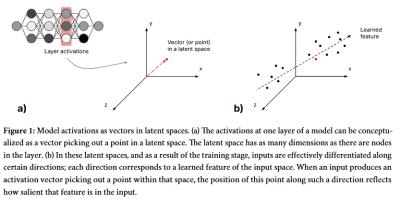
This is a really interesting paper that considers the question of whether large language models (LLM) understand. As the authors write, this depends a lot on what we mean by 'understand'. To clarify, they identify three types of understanding: conceptual understanding, which "involves the model developing internal representations ('features') that are functionally analogous to human concepts; state-of-the-world understanding, which "involves forming an internal representation of the state of the world by grasping contingent empirical connections between features"; and principled understanding, which is "the ability to grasp the underlying principles or rules that unify a diverse array of facts." Through various examples, they show that LLMs can attain all three forms of understanding, however, they do it very differently from how a human would. They employ a variety of mechanisms running in parallel to do so, and hence don't demonstrate the same preference for parsimony - that is, for a single over-riding principle - that humans do. Great paper. Via Pierre-Yves Oudeyer.
Today: Total: [] [Share]