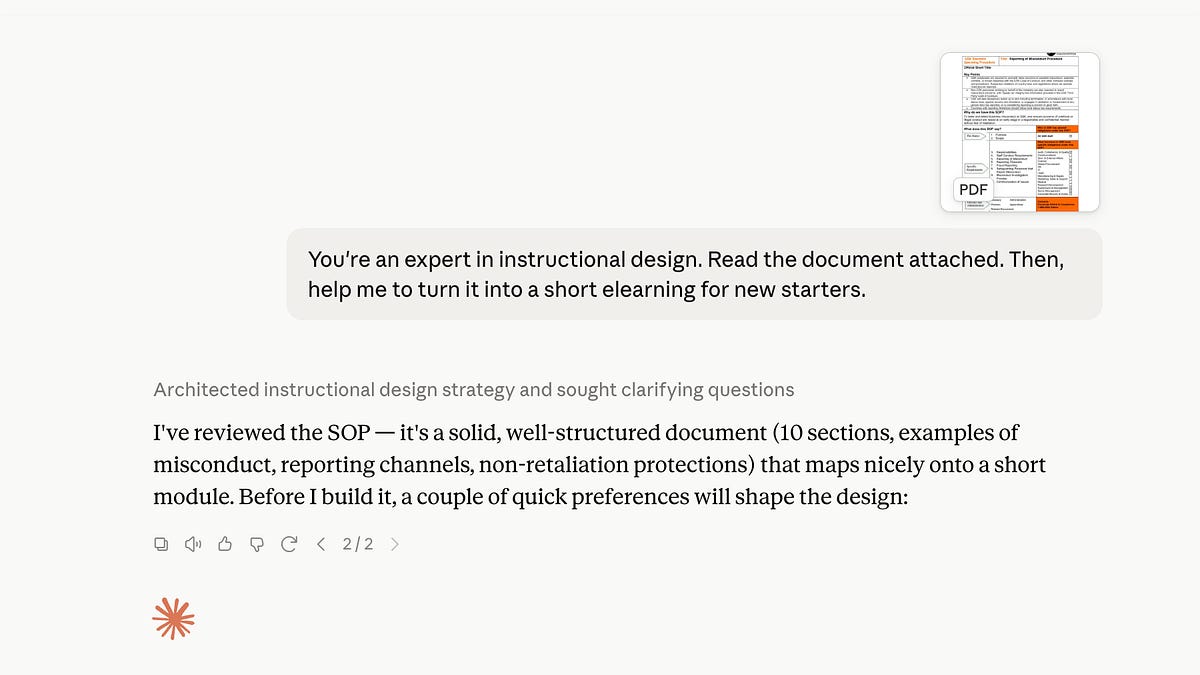
This is definitely an interesting article, though I have issues with it. Here's the scenario: four AI models were given the assignment to create an e-learning course on reporting misconduct at some organization. The article analyzes the results. By and large, the courses are OK. But then comes the criticism: the scenario in question wasn't a knowledge problem, it was a compliance problem, and an e-learning course probably wasn't the right solution at all. I can't dispute that, but if you ask an AI to produce a course, then criticize it because it does that, the criticism seems at best a bit unfair. Here's how Philippa Hardman diagnoses this: "There is an enormous public corpus of finished e-learning... There is almost no public record of the thinking that produced any of it... The conversation where a designer says "this is a willingness problem, not a knowledge problem, so a module won't move it" happens in a room, with no minutes." Well - yeah. But I would also say this: in many organizations (including the one where I used to work) some manager says "we need a course" and nobody pushes back. That's the norm; what Hardman is describing, even if ideal, is the exception. In industries where the norm follows good practice, AI works pretty well. But education is not one of those industries.
Today: Total: [] [Share]