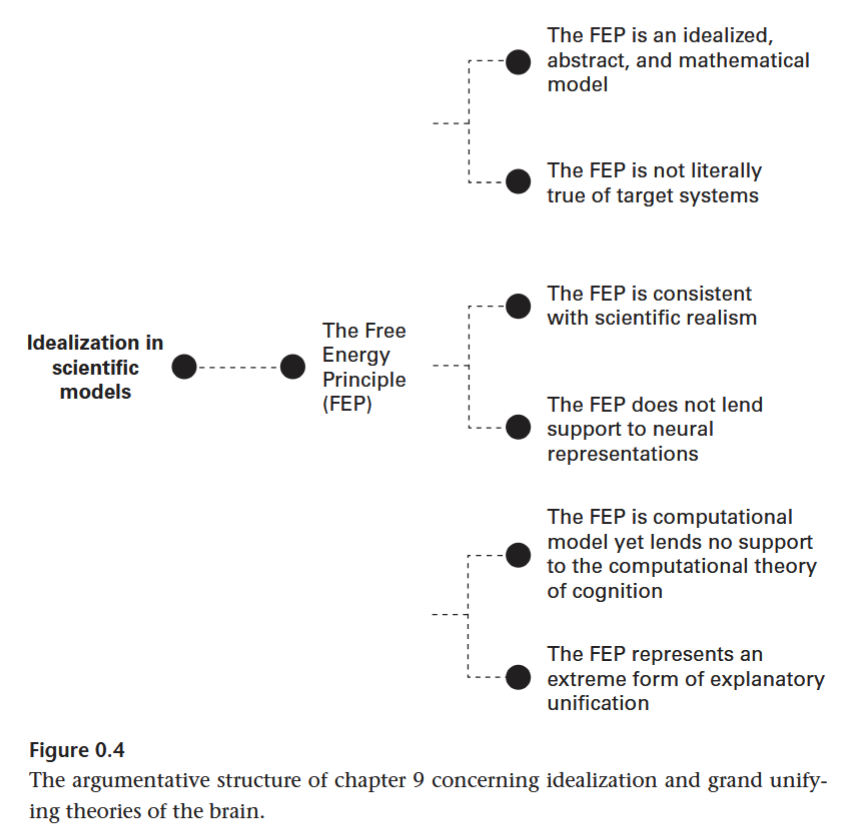
This open access book (249 page PDF) has several themes. The main theme (as depicted by the author) is that 'scientific models are idealizations of the world'. Hence, they don't correspond directly to reality, and are thus not in that sense either true or false. Related to this, "both the representational theory of mind and the computational theory of mind are idealizations." So the question is, are they good models? They are not. "the real value of idealization in cognitive science is that it gives us reason to treat talk of an inner world of contentful representations as merely metaphorical - as a means of acknowledging that we cannot literally mean what we are saying when making use of these theoretical terms." And with this I totally agree. Kirchhoff's argument involves a unifying theory called the free energy principle (FEP) which seems right, but I can't say either way right now - I haven't finished the book (though I will). And I also refer the reader to this discussion in the Brains Blog that offers some back-and-forth argumentation on the main thesis.
Today: Total: [] [Share]