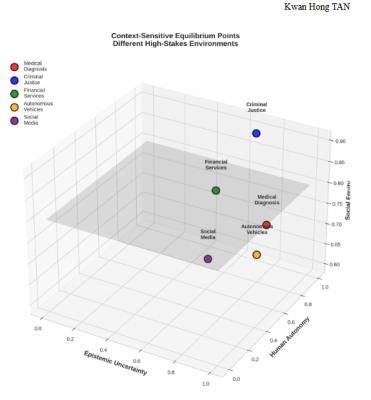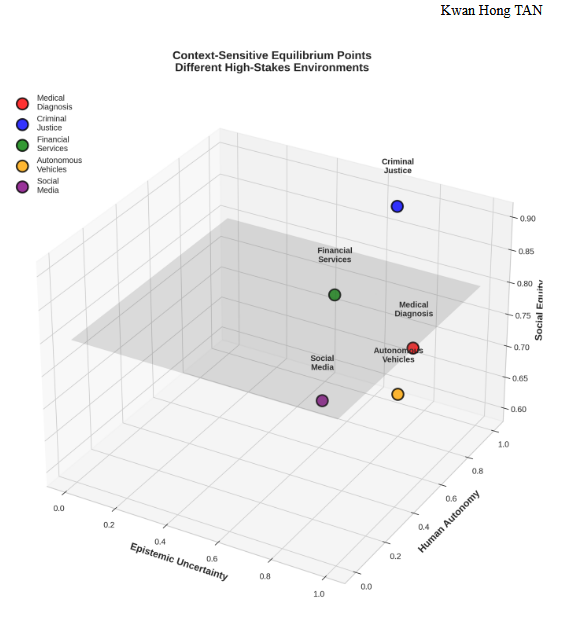
There's a ton of good thinking in this paper (173 page PDF), a thesis proposed by Kwan Hong Tan at the Singapore University of Social Sciences. Most of the heavy lifting is done in the first 30 pages or so, and especially in chapter three, where the Dynamic Equilibrium Theory (DET) is introduced to describe the concept of fluctuational ethics - "the idea that ethical AI systems must be designed to handle not just uncertainty in data or predictions, but uncertainty in the ethical landscape itself." This is a position I also advocate, though it's a hard sell. "Traditional regulatory frameworks assume that compliance can be achieved through adherence to fixed rules and standards. However, Dynamic Equilibrium Theory demonstrates that ethical requirements in AI systems are inherently dynamic and contextual, requiring regulatory approaches that can accommodate continuous adaptation." There's much much more in this as Tan analyzes fluctuational ethics through case studies, describes the mechanics in prototype computer code, and traces in exhaustive detail the implications of this finding in policy and methodology.
Today: Total: [] [Share]