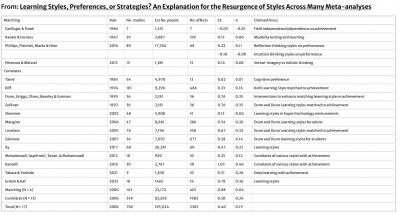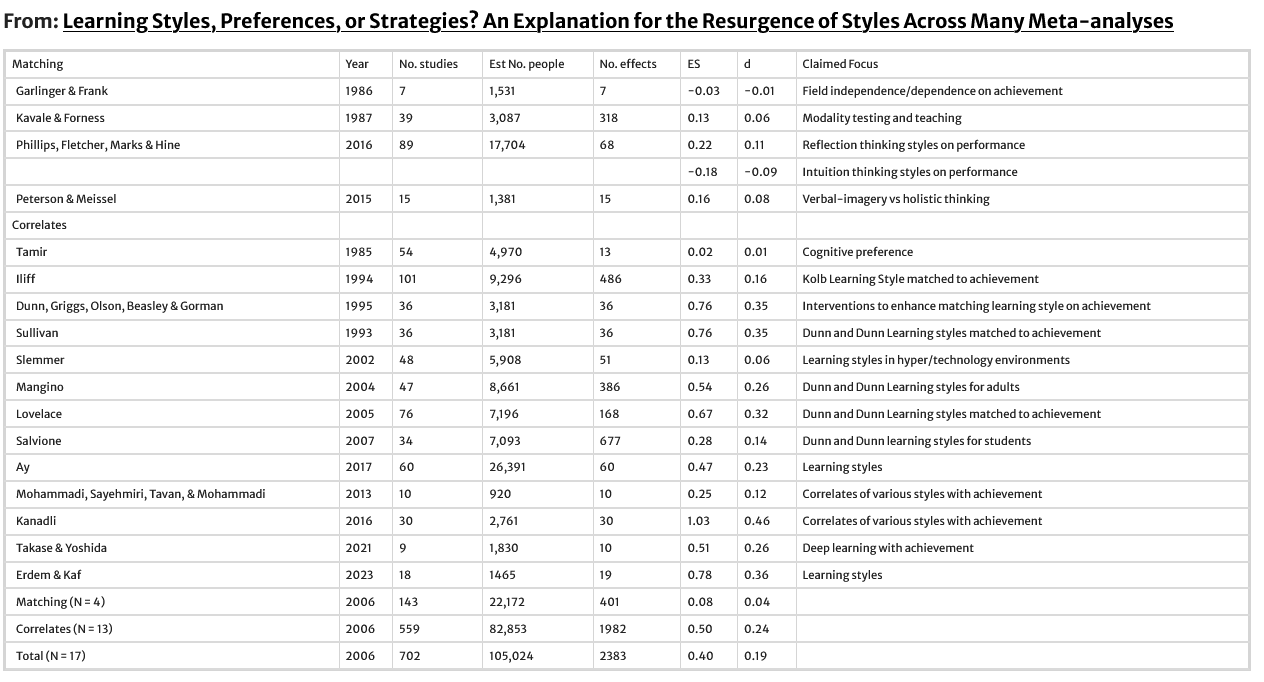
I liked this article a lot. It's a level-headed analysis of the learning styles theory and corresponding hypothesis (specifically: that adapting teaching strategies to learning styles will improve learning outcomes) looking at the evidence for it (there is none) and seeking to explain why people believe it anyways (there's a list of seven 'confounds' that offer plausible explanations). I think the article's greatest strength is that it gets to the heart of the matter: in a nutshell (and in my own words) the whole debate confounds 'teaching strategies' and 'learning strategies'. "Learning is most effective when students develop cognitive and metacognitive strategies tailored to task demands rather than teaching them according to their learning preferences," write the authors. "Educators can foster a more robust and flexible learning environment by emphasizing critical thinking, self-regulation, and meaningful engagement with content." This argument, to my mind, both explains the appeal of learning styles and replaces learning styles scepticism with something that actually accords with our actual learning experiences. But will it be popular with the pundits and learning styles sceptics? Probably not. "There is hardly a hint of commercialism."
Today: Total: [] [Share]