
The Value of Process and Artefact
Tim Klapdor,
Heart Soul Machine,
2026/10/20

Tim Klapdor uses the example of a hamburger to illustrate the difference between process and product, but I think a better example might be the shirt on your back. My grandfather used to manufacture those shits on a farm in rural Quebec. Today, they're manufactured by poverty-level workers in Asia. In the future, they may be manufactured by AI. The shirts are in all cases identical, but the process - and the lives and values it sustained - are very different. Would it be better to have robots make shirts? Maybe. Did people care when the manufacture switched from my grandfather to a wage-slave in a sweathouse? Not really. As Klapdor says, "This isn't a new argument." I think process matters, but I also think the use of new technology is often a better process what what we do now.
Web: [Direct Link] [This Post][Share]
The End of ISTE (Sorta)
Tim Stahmer,
Assorted Stuff,
2026/10/20

As Tim Stahmer reports, ISTE has changed its name from the International Society for Technology in Education to the International Society for Transforming Education. Its new focus "says that while technology 'remains central to the organization's work', it will now only be 'one lever' for 'transforming students' classroom experience'." Stahmer comments, "As I've been ranting about in this space for more than twenty years, we've done a very crappy job of integrating technology into the process of teaching and learning. The devices and software have always had the potential to be transformative. Most of society, however, fiercely resisted attempts to substantially change the institution known as 'school'."
Web: [Direct Link] [This Post][Share]
The Compliance Trap: Rescuing Learning Targets from Administrative Wallpaper
Eric Sheniger,
A Principal's Reflections,
2026/10/20

"For years," writes Eric Sheniger, "learning targets have devolved into a performative administrative ritual. They have become just another box to tick on a weekly walkthrough rubric. Target written in student-friendly language? Check. Visible from all corners of the room? Check. Good to go. That checklist mentality drains the practice of its real power." Checklists have a purpose. They remind pilots to lower the landing gear. They remind surgeons to check which side they're operating on. But they aren't intended to substitute for the full scope of an activity. Everything - including teaching - is complex, and goes beyond simple checklists.
Web: [Direct Link] [This Post][Share]
Rote is back. Or at least something very like it
Melissa Haley,
EduResearch Matters,
2026/10/20

This article offers a response to what is described as a growing trend toward rote teaching, "a form of teaching organised around tightly controlled sequences, pre-determined lessons, fixed pacing, and limited space to adapt, respond or pursue emerging inquiry. This approach shifts teaching practice away from responsiveness to learner need. It is more about following a one-size fits all prescribed script." There's a school of thought out there that suggests all students can (and need to) learn the same way (this is what justified the anti-learning-styles hysteria). "Across many education systems, standardisation is intensifying. Policymakers frame sequenced curricula, explicit lesson structures, and tightly aligned assessments as solutions to uneven outcomes, equity gaps, and workload pressures." There are good reasons to resist. "Rote approaches have long been criticised for producing narrow, surface-level learning, prioritising repetition over understanding and compliance over thinking."
Web: [Direct Link] [This Post][Share]
Tri-Agency Open Access Policy on Publications (2026)
ISED, Government of Canada,
2026/10/20
Canada's 'tri-council'* funding agencies have announced a revised open access requirement for publications. "Each postsecondary institution and research hospital eligible to administer CIHR, NSERC or SSHRC funds is required to develop and publicly share an institutional OA strategy (and) retain sufficient rights and apply an open license, such as a Creative Commons (CC) license, to the Accepted Manuscript (AM) and/or Version of Record (VoR) used to comply with the Policy." In addition, they need to "ensure the peer-reviewed research article is immediately and freely available in a Canadian institutional repository or made available through a trusted Canadian platform at the time of publication, even where the article is freely available on the publisher's website." This replaces an 2015 policy that granted much more to publishers. Via Coalition Publica. (* Canadian Institutes of Health Research (CIHR), Natural Sciences and Engineering Research Council of Canada (NSERC) and Social Sciences and Humanities Research Council of Canada (SSHRC)
Web: [Direct Link] [This Post][Share]
Pedagogical Weight
Ann,
All Things Pedagogical,
2026/10/20
According to Ann (no last name), "there is a weight of expectations that we all carry in eduspace, and sometimes those expectations are things we put on ourselves and not necessarily things folk have put on us realistically." the term, as the title suggests, 'pedagogical weight'. I'm sympathetic, but having worked a variety of jobs over my career, I can attest to the reality that this weight exists in every occupation, save perhaps that involve no mental preparation at all. But that's not to dismiss the fact of the weight. We all feel it, we feel it a little more when people are protesting in the streets, and we feel it in the face of war, disease, and the remaining horsemen. And while it may be that "folk just have no real interest in engaging in virtual spaces as they used to anymore, because.... there's too much weighing on them," it may also be because virtual spaces, as we know them today, don't do anything to address that weight, other than to make it heavier. (p.s. I don't know how it started as a linguistic convention, but the use of 'folk' to refer to 'people' will never not sound strange to me).
Web: [Direct Link] [This Post][Share]
zoomlandia
Todd Conaway,
The Whole Classroom,
2026/10/20
This was Neil Postman in 1985, long before Zoom - or for that matter, the internet - was really a thing. "In courtrooms, classrooms, operating rooms, board rooms, churches and even airplanes, Americans no longer talk to each other, they entertain each other. They do not exchange ideas; they exchange images. They do not argue with propositions; they argue with good looks, authenticity and celebrity." So while I appreciate Todd Conaway arguing here that we should be thinking of more in-person things we should be doing, I would argue that this doesn't solve the problem it's supposed to be solving. If I had to put it in a nutshell, what happened is that (with the rise of suburbia) connection became privilege. Being 'in the room' became the mark of the elite. And online media - at least from my perspective - became a way to push back against that.
Web: [Direct Link] [This Post][Share]
Sovereignty isn't a place
Tom Watson,
Tomcw.xyz,
2026/10/20
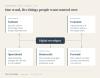
People typically associate sovereignty with a nation or place, but as micro-nations like Sealand demonstrate, sovereignty isn't about place, it's about what you can do. In this post, Tom Watson argues, "sovereignty is about meaningful choice and the ability to act on it. Having alternatives, yes, but also having the knowledge, money, rights and practical means to actually pick one." That means the sovereignty of nations, communities, businesses, organizations and individuals are different. Each has different needs and priorities. Governments are concerned with security while individuals are concerned about their data, for example.
Web: [Direct Link] [This Post][Share]
There are many ways to read OLDaily; pick whatever works best for you:
- Read in your web browser on this web page, updated weekdays
- Receive a daily or weekly email newsletter by subscribing here
- Subscribe to the RSS feed using your favourite feed reader
- Follow @OLDaily@mastodon.social on Mastodon or elsewhere in the fediverse
- Follow @OLDaily on Bluesky
- Read OLDaily as a LinkedIn Newsletter
- Integrate the open API using the JSON feed
This newsletter is sent only at the request of subscribers. If you would like to unsubscribe, Click here.
Know a friend who might enjoy this newsletter? Feel free to forward OLDaily to your colleagues. If you received this issue from a friend and would like a free subscription of your own, you can join our mailing list. Click here to subscribe.
Copyright 2026 Stephen Downes Contact: stephen@downes.ca
This work is licensed under a Creative Commons License.