
A Framework for Assessing Information Literacy in Interactions with AI Chatbots
Axel Bruns,
Snurblog,
2026/09/15

This is another conference session report from Axel Bruns (who I think we should recognize more widely for his ongoing coverage). He writes, "Variables that can be used to assess user approaches here include query design features, output control features, prompting strategies, epistemic trust in AI, user-critical evaluation, and prompt chain logic; while AI responses can be evaluated for their explanation and transparency features, mistakes and hallucinations, and triggers for user follow-ups." Makes sense - but in the back of my mind is the question, are variables the medium through which we should evaluate literacy (or anything, really)? This presumes that literacy is expressed by laws with values that can be defined and measured.
Web: [Direct Link] [This Post][Share]
They’re Covering the Wrong AI Story
Jeff Jarvis,
Medium,
2026/09/15

There's the story of the dangers of AI that has filled the pages of news media, which is the wrong story to cover. Then there is the story about AI CEOs and their "Transhumanism, Extroprianism, Singularitarianism, Cosmism, Rationalism, Effective Altruism, and Longtermism (TESCREAL)" philosophy that "these überwealthy zealots have the resources - technology, capital, celebrity - and access to power to pursue." That is the real story here, according to Jeff Jarvis. "Instead, news media lap up the AI overlords' claims of suprahuman power... (and) treats the self-serving heads of companies that make AI as experts and even intellectuals, though many of them left college early, which is why their frequent manifestos sound like the work of freeze-dried sophomores." The article is overstated and even crude, and definitely too long, but it's not wrong.
Web: [Direct Link] [This Post][Share]
Examining Ungrading as a Tool for Transformative Social Change
Lorelei L. Hanson,
Canadian Journal of Learning and Technology,
2026/09/15

Lorelei Hanson draws on two major premises to make her argument: first, an understanding of "technology as 'orchestrated assemblies, that through technique (technologies enacted by people), include humans," and second, recognition that higher education systems, at least in part, "perpetuate patriarchy, colonialism, and a mindset of exploitation that is contributing to the polycrisis." Together these support the idea that the practice of grading can change and should change. Just so, "ungrading can be used to draw attention to some of the power imbalances and privileges that exist in a classroom, and to give students and instructors more agency and a stronger voice." I think more needs to be said than this; even the retention of pass/fail evaluations, without specific grades, will continue to reinforce existing epistemologies and power structures. What does a university look like when the objective is no longer for it to define truth and correctness?
Web: [Direct Link] [This Post][Share]
Quick Deep Dive: Microsoft Is Vying to Be the “Safe” AI Company for Schools
Alex Sarlin,
Edtech Insiders,
2026/09/15

The story is told in the headline and through two key items: "First, Microsoft, alongside the American Federation of Teachers and the United Federation of Teachers, is working to create a National AI Safety & Privacy Standard for schools." And second, "Microsoft AI CEO Mustafa Suleyman just introduced a broader Humanist AI Code of Conduct, built around the idea that AI should remain under meaningful human control." These two things, of course, aren't actually software or programs, and don't by themselves actually make Microsoft any safer than anything, but as Alex Sarlin suggests, they could single a wider strategy.
Web: [Direct Link] [This Post][Share]
Making Generative AI Expectations Visible: Extending the TILT Framework for Transparent Assignment Design | Online Learning
Andrew Wiss, et al.,
Online Learning,
2026/09/15
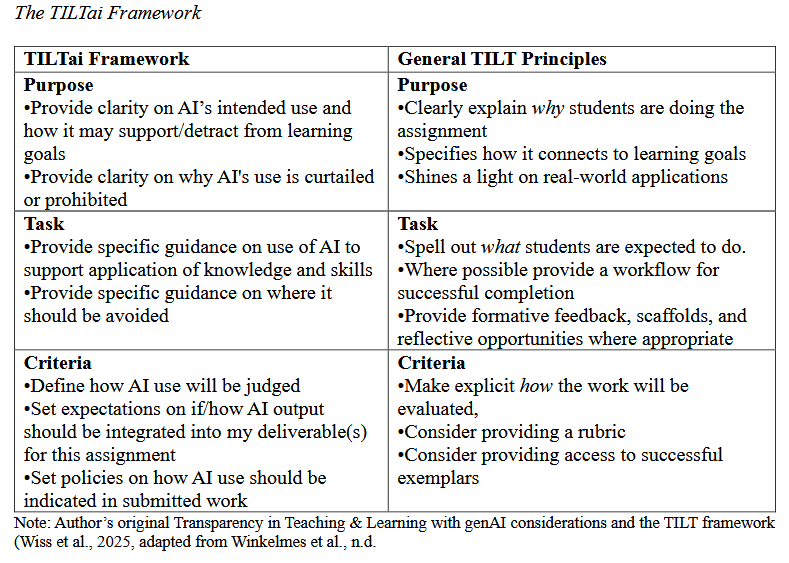
Citing "limited scholarship related to scale-based tools to measure genAI transparency," the authors modify the Transparency in Learning and Teaching (TILT) Framework to create a TILTai Framework that is "inclusive of instructors' intentions surrounding genAI use... to provide students with transparent genAI guidance." Additionally, they "introduce a new and preliminarily validated instrument for measuring student perceptions of a particular assignment's transparency related to genAI (the TILTai Scale)." I think they should have integrated the AI part a lot more closely with the original TILT framework; a lot is lost in the translation (see image). For example, instead of saying why AI is used or not used, the framework only considers "how it may support/detract from learning goals," which is hardly sufficient.
Web: [Direct Link] [This Post][Share]
Beyond the Thread: Reimagining Online Discussions for Authentic Learning
Diane Johnson, Kelly Brown, Kaye Shelton,
2026/09/15

The topic of online discussion interests me a lot, so this examination of alternatives to the traditional threaded discussion lisst in online learning captured my attention. Based on a study informed by a modified* Community of Inquiry (CoI) framework, the authors found that "collaborative discussions, in which students selected their own platforms, meeting times, and conversational approaches in smaller groups, produced deeper critical thinking, stronger relational development among peers, and greater student ownership of the learning process compared to traditional threaded discussions." In particular, "three themes emerged in our shared reflections: authenticity of the engagement, student empowerment in choice, and deeper learning in the structure." (*) The fourth form of 'presence' listed is 'learning essence', though they must have meant 'learning presence', based on their own references. See my discussion of related issues.
Web: [Direct Link] [This Post][Share]
Doing it all: Exploring roles and responsibilities of and support for online program coordinators
Yvonne Earnshaw,
2026/09/15

This article is a study of program support coordinators (PSC) at American universities and is based on a series of interviews with PSC along with the usual background research. My cynical self says this article will be used to train AI some time in the future (to be clear, the author has no such intention). Though there is little in the way of a formal definition, onboarding, or evaluation metric, the role seems to boil down to: enrollment management, curriculum and program infrastructure, faculty and student support, personnel-related responsibilities, and other duties. It seems clear that faculty drafted in to such roles have little to no training or expertise in it when they start. "Most faculty are not prepared to be in an online program coordinator role, nor do they have expertise or even basic knowledge in areas like enrollment management, accreditation, social media and marketing, recruiting, admissions processes, and hiring processes."
Web: [Direct Link] [This Post][Share]
There are many ways to read OLDaily; pick whatever works best for you:
- Read in your web browser on this web page, updated weekdays
- Receive a daily or weekly email newsletter by subscribing here
- Subscribe to the RSS feed using your favourite feed reader
- Follow @OLDaily@mastodon.social on Mastodon or elsewhere in the fediverse
- Follow @OLDaily on Bluesky
- Read OLDaily as a LinkedIn Newsletter
- Integrate the open API using the JSON feed
This newsletter is sent only at the request of subscribers. If you would like to unsubscribe, Click here.
Know a friend who might enjoy this newsletter? Feel free to forward OLDaily to your colleagues. If you received this issue from a friend and would like a free subscription of your own, you can join our mailing list. Click here to subscribe.
Copyright 2026 Stephen Downes Contact: stephen@downes.ca
This work is licensed under a Creative Commons License.