
Nvidia, Microsoft, Meta warn against 'premature restrictions' of open-weight models
Ashley Capoot,
CNBC,
2026/07/27

The letter, sourced from Nvidia and signed by dozens of tech companies (including OpenAI, as of today) supports open weights AI models and warns against potential restrictions on them. "Our AI leadership will be judged not by one frontier AI model, but by whether the United States builds a strong, open ecosystem that diffuses into every sector," the letter said. "This is essential for creating opportunities for innovation and prosperity across the country." Related: Jeff Jarvis, AI Communism.
Web: [Direct Link] [This Post][Share]
Framework Maps
A. Jacobs,
Reality Drift Archive,
2026/07/27
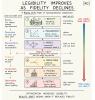
This is an interesting framework representing how systems become less connected with reality over time. "Reality becomes compressed into metrics, optimization systems, representations, and narratives..." writes A. Jacobs. "Representation and optimization make reality easier to use while weakening semantic fidelity... reality is compressed through science, institutions, media, public narrative, and individual belief... systems become more internally consistent as contact with original conditions weakens." I think there's something to this; certainly the emphasis on formal metrics obscures complexity, which results in increasing abstraction away from that complexity. Whether we're talking about 'reality' and 'systems', or just a formal property of abstraction, could be a matter for debate.
Web: [Direct Link] [This Post][Share]
Who Is Ed-Tech For?
Audrey Watters,
Second Breakfast,
2026/07/27

Audrey Watters asks the right question here, and after spending 25 years working in a government research organization I can confidently state the answer: whoever will pay for it. Because that's the focus, right? The way we've set up our economy as a whole: the product is designed for the customers, and the customers are those who pay the bill, which is why social media and television are designed for advertisers, and edtech is designed for institutions, governments and enterprises. Now Watters asks this in the context of Anthropic's announcement of 'Claude for Teachers', asking "why bypass district decision-making and district governance" and market directly to teachers? The answer is, they're not marketing to teachers; they're still marketing to the boards and institutions that will pay for the software. Because while edtech (including Claude for Teachers) should be designed for students, or maybe teachers, the main lesson I learned in those 25 years is that there is no market for that.
Web: [Direct Link] [This Post][Share]
Look on my Outcomes, ye Mighty and despair
Hollis Robbins,
Anecdotal Value,
2026/07/27

The university environment is ripe for this sort of attack despite its baseless generalizations ("nobody checks quality", "most college courses in America are knockoffs of some original", "no faculty member ever... goes back and looks at the learning outcomes") and loopy proposals ("I would be thrilled to have more conservative and libertarian professors scheduled to teach small seminars simply refuse to list learning outcomes"). The suggestion is that learning outcomes are intended to standardize courses, degrading from some idealized version (a.k.a. the Cheesecake Factory principle). This eliminates the differentiation that 'quality' programs institutions can establish "non-fungible with the rest"... "to build a new, valued brand." Where is this quality? It is found, according to Hollis Robbins, in the professors. "Professors are the quality product." My counterpoint: what is the response to the objection that 'conservative professors' are of lower quality than 'progressive professors'? That would explain (if it were a fact) why universities select the professors they do. That would explain why some sort of 'equal opportunity program' is required to ensure otherwise unhirable 'conservative professors' are awarded professorial positions. That would explain why students need to be enticed or even forced to take courses from these professors. Now I agree - learning outcomes and associated assessment practices are a weak point in the system. But replacing the entire system with conservatives is (giggle) hardly the answer.
Web: [Direct Link] [This Post][Share]
Becoming Skilled at Making Documents
Anil Dash,
2026/07/27

'Skills' are structured sets of instructions adding functionality to an AI model (Claude skills, ChatGPT skills). This article outlines a 'better documents' skill. It can be executed via a command or in appropriate contexts. A document-writing skill, for example, would be activated when the model is asked to 'write an article' or 'review this memo'. A skill is contained in a folder with a number of standard files (here's Anil Dash's better documents skill on GitHub). What interests me is how the content could help humans, as well as AIs, create better documents. It addresses things like structure and design, helping authors watch for and correct things like unactionable requests or hidden conclusions (the 'mystery novel' structure so common among novice writers who were taught that the conclusion is stated at the end). For this reason, I think it would be a good learning exercise to have someone design their own skills for writing documents or any other creative task (even if they never use it in an AI). Related: record a skill.
Web: [Direct Link] [This Post][Share]
HubSpot agent cuts 350 hours a year for Ignite Reading across 25 states
Luis Rijo,
PPC Land,
2026/07/27

PPCLand is a digital marketing newsletter (from Pay Per Click (PPC)). HubSpot is a customer relations management (CRM) platform service supporting a wide variety of clients, including Ignite Reading, an early literacy tutoring service. The headline describes a time-saved benefit, but the real story is the service, which manages AI agents as they work across data sources, allowing users to manage them and ensure they work cooperatively, rather than in isolation from each other. "The absence of field mapping is the technical claim that carries the most weight. Field mapping is where most CRM automation projects consume budget, and where they most often break. An agent that inherits the schema rather than negotiating with it removes a class of integration work - assuming the claim holds under load, which a public beta will test."
Web: [Direct Link] [This Post][Share]
There are many ways to read OLDaily; pick whatever works best for you:
- Read in your web browser on this web page, updated weekdays
- Receive a daily or weekly email newsletter by subscribing here
- Subscribe to the RSS feed using your favourite feed reader
- Follow @OLDaily@mastodon.social on Mastodon or elsewhere in the fediverse
- Follow @OLDaily on Bluesky
- Read OLDaily as a LinkedIn Newsletter
- Integrate the open API using the JSON feed
This newsletter is sent only at the request of subscribers. If you would like to unsubscribe, Click here.
Know a friend who might enjoy this newsletter? Feel free to forward OLDaily to your colleagues. If you received this issue from a friend and would like a free subscription of your own, you can join our mailing list. Click here to subscribe.
Copyright 2026 Stephen Downes Contact: stephen@downes.ca
This work is licensed under a Creative Commons License.