
Academics Need to Wake Up on AI
Alexander Kustov,
2026/03/03

I'm sure a lot of the articles I've been reviewing for OLDaily are AI-authored, though it is getting increasingly difficult to tell. In a certain sense, it doesn't matter, because what I'm always interested in is whether the content is accurate, clearly expressed, and in some sense novel (by that, I mean 'novel to me', which leaves a lot of room for both humans and AIs). This article passes the test, though many readers won't like the message: "AI can already do social science research better than most professors... (and) The academic paper is a dead format walking." It's the same thing for academic papers as it is for software: we can produce a high-quality paper in a few minutes with AI. So why on earth would we pay any money for one? Now there's still a bit of a supply-chain issue: if the AI is to stay current it needs input from somewhere. But probably not from academic papers. Via Paul Prinsloo, who I can just envision walking around muttering to himself after reading this.
Web: [Direct Link] [This Post][Share]
We Said This Ten Years Ago. The World Finally Caught Up.
Ruth Crick,
2026/03/03
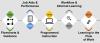
Ironically, I'm reading this the day after being interviewed about the origins of our connectivist MOOCs. Here's what Ruth Crick says, "We were asking people to make a fundamental shift in their mental model of what learning is. The dominant model - and it still exists everywhere - treats learning as the acquisition of content. You attend a course. You receive information. You are now 'trained.' Tick the box, move on. What we were describing was something categorically different. Learning as a dynamic, relational, embodied process — inseparable from identity, from purpose, from the quality of relationships." Ten years after our MOOC, it was still ten years ahead of its time. Via some post in LinkedIn that disappeared in an unasked-for LinkedIn refresh and is now impossible to find. Image: Learning Guild article on the same topic. I also like this 2019 image from Nick Shackleton-Jones. And of course my own classic.

Web: [Direct Link] [This Post][Share]
The New Blackboard Emerges From Bankruptcy
Phil Hill,
On Ed Tech,
2026/03/03

Blackboard has emerged from bankruptcy, reports Phil Hill. "Court filings and company statements show a fundamentally reset organization: virtually no debt, $70 million in new financing, and Matt Pittinsky set to return as CEO once his non-compete and NDA obligations with competitor Instructure expire." Various assets were acquired by Ellucian and Encoura, with Anthology keeping the remainder. But as Hill notes, "Nexus and Oaktree now control the company. The board structure makes this clear: Nexus and Oaktree each designate multiple directors and together anchor the executive committee."
Web: [Direct Link] [This Post][Share]
Discernment: the AI skill no one’s building
Sean Stowers,
WeLearn,
2026/03/03

The AI skill people are lacking, says Sean Stowers, is 'discernment', "the ability to decide whether AI belongs in a given task, which tool fits the situation, what good output actually looks like in your specific context, and when the situation calls for your own expertise instead." He cites 'Learning & AI strategist' David Chestnut, who writes that people focus on skills rather than behaviour change. "People can understand AI, relate to it differently, and still revert to old ways of working. Not because they don't get it - but because behavior change has always been hard." None of this is wrong per se but it's too narrow (and people, are talking about it). It's more than behaviour change, more than 'get on board with the new strategy', more than just 'hard'. It's like they're suggesting people take a leap of faith, but there's more to faith than a leap.
Web: [Direct Link] [This Post][Share]
When AI tools give you choices but take your agency
Open Thinkering,
2026/03/03

What Doug Belshaw is describing here is what I've called 'regression to the bland'. When AI reduces a large body of things to what it thinks you will want to see (no matter how well founded) it tends to exclude "are unusual or fit a different profile than you were expecting are quietly removed from view." I experienced this when I was using Feedly's AI Leo to narrow down RSS results. The results were nothing unusual or surprising, which is not what I want when creating a newsletter like OLDaily. Belshaw also makes the useful distinction between choice - where we select from future options - and agency - where we actually shape these options.
Web: [Direct Link] [This Post][Share]
Stop Looking for the Right Answers about AI – Look for the Right Questions
TeachOnline,
2026/03/03

Regular readers might detect a familiar cadence and thought process behind this article, though I'll admit it has gone through some editing before making it to this page. Basically the intent is to offer a reframing exercise, shifting from the mostly fear-based approach we see in traditional media and (sadly) a lot of blogs, and toward a more agency and action-oriented approach that better serves students and instructors. That's just my interpretation, at least.
Web: [Direct Link] [This Post][Share]
There are many ways to read OLDaily; pick whatever works best for you:
- Read in your web browser on this web page, updated weekdays
- Receive a daily or weekly email newsletter by subscribing here
- Subscribe to the RSS feed using your favourite feed reader
- Follow @OLDaily@mastodon.social on Mastodon or elsewhere in the fediverse
- Follow @OLDaily on Bluesky
- Read OLDaily as a LinkedIn Newsletter
- Integrate the open API using the JSON feed
This newsletter is sent only at the request of subscribers. If you would like to unsubscribe, Click here.
Know a friend who might enjoy this newsletter? Feel free to forward OLDaily to your colleagues. If you received this issue from a friend and would like a free subscription of your own, you can join our mailing list. Click here to subscribe.
Copyright 2026 Stephen Downes Contact: stephen@downes.ca
This work is licensed under a Creative Commons License.