
What if we connected education to the needs of our economies?
Efosa Ojomo,
Christensen Institute,
2018/04/06

I think a lot about why we are teaching as well as about what we are teaching and of course how we are teaching. This post suggests (as we have so often heard before) tying education to the economy. Education, writes Efosa Ojomo, is depicted as a means to gain employment and climb the economic ladder, but "we see, time and time again, is that when education is disconnected from the needs of the economy, this promise falls flat." But what are, I ask, the needs of the economy? For Ojomo, it means "strengthening the connection between schools and employers." But to the employers, the economy succeeds when there is surplus labour and low wages. It succeeds when people don't really have a choice but to accept whatever job they're given, at whatever wage they're offered. The best education helps people be independent of the economy, so that when it fails (as it always does) the people will survive.
Web: [Direct Link] [This Post]
Magic AI: these are the optical illusions that trick, fool, and flummox computers
James Vincent,
The Verge,
2018/04/06

A Reddit item on designing chess pieces cites this article from last year about something called 'adversarial images' - these are patterns that can fool an artificial intelligence into thinking one thing is something else. See also. It might make a face recognition system think you're the pope. Or it might cause a system to identify something as a weapon, or worse, an accordion. One thing that's interesting is that "the same fooling images can scramble the 'minds' of AI systems developed independently by Google, Mobileye, or Facebook, reveals weaknesses that are apparently endemic to contemporary AI as a whole." Near the end of the article is an even more interesting nugget: "the same category errors made by AI and their decision boundaries also exists in the world of zoology, where animals are tricked by what scientists call 'supernormal stimuli.'"
Web: [Direct Link] [This Post]
Meet the 'Study Tubers': The YouTubers making studying cool
Sophie van Brugen,
BBC News,
2018/04/06

This is a short BBC video profiling 'study tubers' - people who are in school and record study tips and share advice with their friends. The videos are called 'revision videos', as in "revision for school exams". The speaker is named Jade and here is her YouTube channel (BBC doesn't link to it for some reason; I had to search for it). Here's one called Revision With Eve. Also Ibz Mo from Cambridge. Even some teachers are getting into the act. There are also revision music videos, like this. I had never heard of the concept of 'revision' when I was in school, but the study techniques weren't new to me. My own approach was analytical: I would organize and classify concepts, rewriting books, lectures, whatever, creating logical structures out of the material, which in turn were easy to remember. A lot like this. Also: no cramming. Ever. You'll notice that I still learn by rewriting - that's how this newsletter gets created.
Web: [Direct Link] [This Post]
8 French Startups Revolutionizing Career Counseling
Camille Pons, Nina Fink,
Actualités EducPros,
2018/04/06

This is a short English version of a slightly longer article in French. What I like is that each of the eight companies takes a different approach to career counseling. Pixis uses a constellation of 731 careers. Impala has an interactive career map that adapts to user responses. Studizz Bot uses high school students’ academic profiles. And so on.
Web: [Direct Link] [This Post]
5×5 R’s of Ours (An OER17 Flashback)
Brian Lamb,
Abject,
2018/04/05

The premise is simple: "We knew that the 5 Rs were a useful and powerful shorthand to capture the permissions inherent with open educational resources… But were there other Rs that captured the messy, energizing, frustrating and life-affirming elements of being a live human being that is learning?" ooo, I want to play; here's a set for idealists: recognize, reclaim, restore, raise, reify. I also like that the lists were licensed with Copylove. This looks like Creative Commons, but with more ontology and less law, something I can get into. My main objection to Creative Commons in general is that it lets the lawyers win, when really, I don't want to grant them any claim at all over what I do with my work. Copylove, it seems to me, lets the artists win.
Web: [Direct Link] [This Post]
Announcement: Spectrum goes Open Source!
Max Stoiber,
Spectrum,
2018/04/05
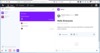
I love rabbit-holes. Here's one. This post announces that Spectrum has gone open source. "Spectrum makes it easy to grow safe, successful online communities that are built to last." There's definitely a need for this, so I logged in, created my account, and started exploring. I created a community for MOOCs and joined a one-member community for e-learning. That member, Justin Mutchell, linked to a GitHub repository for something called the Adapt framework, which is supports an "e-learning authoring tool that creates fully responsive, multi-device, HTML5 e-learning content." Here's their showcase. I tried to load the course in a gRSShopper iFrame, but it wasn't happening (maybe because of browser security limitations).
Web: [Direct Link] [This Post]
Facebook Scans Your Messenger Conversations and Sometimes Humans Read Them
Justin Pot,
How-To Geek,
2018/04/05

My view is: just stay away from anything related to Facebook. " Facebook routinely scans your Messenger conversations, and in some cases human employees may review them." As Justin Pot writes, " Facebook, for what its worth, says that Messenger conversations are not scanned for advertising purposes. I can’t help but wonder how long that stays true." As he notes, Google has been scanning email for this purpose for a decade (which is why I don't use Gmail).
Web: [Direct Link] [This Post]
Padlet’s Price Update Riles Teachers, Raises Questions About Sustainability of Freemium Models
Tony Wan,
EdSurge,
2018/04/05

I have long argued inside government circles that we should be setting up and offering services like this as part of our overall support to education. This is the approach that has been undertaken with success elsewhere and the approach that underlies support for things like BC Campus and Campus Ontario. In this article, we see clearly why. The once free service Padlet will now cost about $10 a month. That's not a lot, but school budgets are too inflexible to allow for this (and while I know a lot of teachers will pay it out of their own pocket, they shouldn't have to). More: Miguel Guhlin.
Web: [Direct Link] [This Post]
Is ‘Reproducibility Crisis’ Overblown?
Rachael Pells,
Inside Higher Ed,
2018/04/05

A new study has failed to reproduce the reproducibility crisis. "A review of more than 40 recent studies on reproducibility has led Daniele Fanelli, a fellow in methodology at the London School of Economics and Political Science, to conclude that, although misconduct and questionable research methods do occur in 'relatively small' frequencies, there is “no evidence” that the issue is growing." This summary illustrates the problem perfectly. Different metastudies produce different results, depending on the studies they accept as valid. The phrase 'relatively small' is subject to interprtation. And the assertion that it is 'not growing' is very different from 'it does not exist'.
Web: [Direct Link] [This Post]
Publication of LRMI controlled vocabularies
Stuart Sutton,
Learning Resource Metadata Initiative, Google Groups,
2018/04/04
I'm just reposting this verbatim, because it's chock-full o' links. "DCMI and its LRMI Task Group are pleased to announce the publication of a set of controlled vocabularies (enumerations) for use with existing schema.org learning resource properties. The vocabularies have been described using the Simple Knowledge Organization System (SKOS) and serialized in RDF Turtle.
- Alignment Type for use with schema.org/alignmentType
- Educational Audience Role for use with schema.org/audience
- Educational Use for use with schema.org/educationalUse
- Interactivity Type for use with schema.org/interactivityType
A fifth vocabulary identifying the learning resource type for use with schema.org/learningResourceType is still in development. These vocabulary additions can be found on the LRMI website at http://lrmi.dublincore.org/specifications/concept_schemes/."
Web: [Direct Link] [This Post]
The CWiC Framework: Context around Courseware
Michael Feldstein,
e-Literate,
2018/04/04

This post is mostly a video about the Courseware in Context (CWiC) framework, which you can read about here. The idea of CWiC is to "help you make better-informed adoption and implementation decisions with the goal of advancing the adoption of high-quality digital courseware in higher education." As Michael Feldstein says (and I concur) "We've seen repeated failures in the market to create selection tools for curricular materials or edtech products." The approach of CWiC is to place these selection decisions into context. There are, as Tanya Joosten's says "'a million' different contextual variables, from classroom implementation to support to individual student needs." Thus "CWiC is an attempt to take a traditional product selection tool model and enrich it enough to account for all these contextual variables."
Web: [Direct Link] [This Post]
How babies learn – and why robots can’t compete
Alex Beard,
The Guardian,
2018/04/04

This article blends to major streams of thought: the first, as suggested in the title, describing how children actually learn (hint: it's not the encoding of content knowledge; that's how robots learn, not people), and the second, relating this to failed attempts to 'school' children from lower socio-economic backgrounds by cramming them and force-feeding them. "Erika Christakis, early-childhood expert and author of The Importance of Being Little, charts the slow descent in preschool learning from a multidimensional, ideas-based approach to a two-dimensional naming-and-labeling curriculum." I would add the word "yet" at the end of the title. Robots are not yet adaptive and interactive, but they will be. And that's when they'll slowly begin to assist learning.
Web: [Direct Link] [This Post]
Millennials destroyed the rules of written English – and created something better
Rachel Thompson,
Mashable,
2018/04/04

I have written in the past (in Speaking in LOLcats) how internet users have created a new online language of their own using (for example) images. This article describes how English-speaking internet users (not just 'millennials' and not all 'millennials') have reshaped some of the conventions of written language as well, using punctuation, capitalization, and abbreviation in non-standard ways. This isn't new to the most recent generation of internet users :) and probably won't stop happening.
Web: [Direct Link] [This Post]
Forged in wildfires: Lessons from California student-reporters
Anne Belden,
Columbia Journalism Review,
2018/04/04

I'm not recommending that we send students into wildfires in order to improve their education. But the lessons learned by these student journalists will never be forgotten. “I was flipping between journalist mode and ‘that’s-my-home’ mode,” said one student journalist. “As it got closer to my house, the priorities started to shift. It was almost fluid.” The article offers some good advice on how to support student journalists (advice, really, that could apply to almost any sort of field work done by students). "Their skill sets advanced a year and, in three intense weeks, they transitioned from student-reporters to journalists."
Web: [Direct Link] [This Post]
Teaching Strategies for Critical Thinking Skills
Janelle Cox,
TeachHub,
2018/04/03
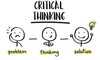
This is exactly the sort of nonsensical article I was trying to protect people from with my Critical Thinking for Educators post last week. Janelle Cox's article is unmitigated nonsense. The five 'strategies' for " getting our students to use their higher-order thinking skills while learning" are: encouraging students to think for themselves, helping students make connections, activating students' prior knowledge, placing students into groups, and activating the turn-around strategy. These might (or might not be) good bits of advice, but they have utterly nothing to do with critical thinking. Posts like this are just so much noise and do nothing to advance good teaching or good learning.,
Web: [Direct Link] [This Post]
Data-based decision making on students’ mathematical achievement: no effect
Jonathan Kantrowitz,
Education Research Report,
2018/04/03
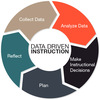
Wouldn't it be something if the data showed that there was no effect to be had from using data-driven decision-making (DBDM) in education? The paper from last June this short post is based on is locked behind a subscription paywall, so there's no way of verifying the report or finding any other nuance in the study (yet another case of why it's so frustrating that people actually publish this way - it's like they don't want to be read). This result is probably a misinterpretation. But if it isn't, my guess is that it would all even out: the benefit you get from an intervention on one person is offset by the disruption the intervention causes to another. Plus, maybe, treating students like robots. But let's not get too excited; as with all such studies there's another with contradictory outcomes; you can find one from 2015 here. And here's a paper outlining all the factors related to DBDM implementation in schools.
Web: [Direct Link] [This Post]
The Edublogger’s Guide To Podcasting
Kathleen Morris,
The Edublogger,
2018/04/03

This guide from Edublogs is for educators and dips into the now-rich history of educational podcasting to create an every-teacher's guide. It's funny how podcasting was all the rage for a while, went out of fashion, and now has returned with a vengeance. No matter: I'm just happy to see it. And there's this: "The main reason I like podcasts is because you can consume content while doing something else— exercising, driving, cleaning the house etc.... podcasts allow a lot more flexibility to learn or be entertained on-the-go than other sorts of media like video or written text. Podcasts are also free! You don’t need to buy a book or sign up for a course to learn something new. With hundreds of thousands of podcasts available, there’s a good chance there’s a podcast on a topic you’re interested in."
Web: [Direct Link] [This Post]
College for all — but not college degrees
Joanne Jacobs,
Linking and Thinking on Education,
2018/04/03
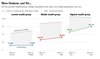
As always, I am suspicious when reading a Joanne Jacobs column, but this one seems backed by good data and (even more importantly) good intentions. In a nutshell, " More first-generation, low-income students are going to college — but not completing a degree, writes David Leonhardt in the New York Times. " Obviously this is a concern because these students are accumulating a huge debt load, but not the earning power required to offset that. " I’m convinced that the college-graduation problem is one of the big barriers to economic mobility," writes Leonhardt in the Times. I'm thinking that whatever is preventing them from graduating is also that big barrier to economic mobility, and one that won't be addressed simply by increasing graduation rates.
Web: [Direct Link] [This Post]
In Defense of Design Thinking, Which Is Terrible
jenkinsEar,
Metafilter,
2018/04/03

This is a really interesting pair of presentations. In one, mostly a video, Natasha Jen criticizes the idea of design thinking. “Why did we end up with a single medium?" she asks. "Charles and Ray Eames worked in a complete lack of Post-It stickies. They learned by doing.” In response, Khoi Vinh argues, "it matters less to me whether it leads to a lot of bad design or not. What matters to me is whether it helps broaden the language of design, if it helps expand the community of design, if it helps build a world that values and understands design better than it does today." I fit more into the 'design by doing' school, though I've certainly heard from the other side around here.
Web: [Direct Link] [This Post]
Philosophical Implications of New Thought-Imaging Technology
Justin Weinberg,
Daily Nous,
2018/04/03

We have always taken for granted the fact that our thoughts are private. The developments described in this article challenge that idea. " Dan Nemrodov at the University of Toronto-Scarborough is working on a way to use electroencephalography (EEG) and machine learning to digitally reconstruct the images that subjects are seeing. In other words, he is developing a kind of mind reading technology." More here and here. Before encoding it and signing up hundreds of millions of users, let's first ask: what are the ethical implications of this: "communications for the impaired or ill, evidence for criminal investigations, opportunities for commercial data mining, new forms of art creation, etc"? And in education: could we 'know' what a person 'knows' by using this technology to 'read' their mind?
Web: [Direct Link] [This Post]
Teachers and students create interactive STEM lessons that inspire, motivate, and teach others
Microsoft,
2018/04/03

In a conversation with Doug Belshaw this morning we discussed the idea of student-produced open educational resources (OERs), how they didn't have to be high-quality and glossy to be effective, and how the metaphor of 'learning exhaust' might not be the best way to describe them (what would be better: 'learning by-products'? 'learning productions'?). This Microsoft post from yesterday describes the same idea (but in a specifically Microsoft-branded way, of course). The story focuses on José Pedro Almeida, a 12-year-old student from Portugal. “Mr. Sousa encouraged us to learn programming, and we created a project to motivate other students and teachers to learn programming, too,” José says.
Web: [Direct Link] [This Post]
The Missing Building Blocks of the Web
Anil Dash,
Glitch, Medium,
2018/04/03

Anil Dash, still with Glitch, is continuing to advocate "the idea that the web was supposed to be made out of countless little sites." This is something that resonates with me as well. The missing building blocks, he writes, are the technologies that made the old web work: the idea that you could view source and use what you saw to create your own web site; embedding bits and pieces of one website on another (the way we used to do with Flash, and the way I still do with videos and slide shows); having your own web address. In a follow-up article Mike Loukides adds to the list things like RSS, which creates simple syndication, along with better security and privacy.
Web: [Direct Link] [This Post]
Amazon Peer Review: Coming To A Preprint Near You
Phil Davis,
The Scholarly Kitchen,
2018/04/02

That sound you heard was academic journals everywhere going "uh, oh". They don't need to worry just yet, it's just an April Fools joke. According to this article, " Starting today, anyone shopping on Amazon will soon be able to review manuscripts... Amazon Peer Review™ works by linking Amazon’s online store to bioRxiv, a rapidly expanding source for preprints in the biomedical sciences. Ratings will be tagged to manuscripts with an Amazon-branded quality badge." Yes, it's just a joke, but how bad would it be, really?
Web: [Direct Link] [This Post]
Why No One Finishes An Online Course—And Why It Doesn’t Matter
Tyler Basu,
Influencive,
2018/04/02

This post reads like marketing but it still makes a pretty good point. "Your customers aren't going to buy your course because they want to learn everything you know about XYZ topic. They’re going to buy your course because they want to achieve a specific result. To them, your course is just a way to learn how to get that result. It’s the result they value, not the information." If they get that result, the course was valuable, even if they didn't finish the course.
Web: [Direct Link] [This Post]
It's Time for an RSS Revival
Brian Barrett,
Wired,
2018/04/02

I of course have never given up on RSS and use it every day as an ad-free user-selected searchable alternative to the social media newsfeed. And I think it's worth noting what Ben Wolf (of The Old Reader) said when Google killed its reader five years ago: "How long will it be before your Facebook stream is so full of promoted content, bizarre algorithmic decisions, and tracking cookie based shopping cart reminders that you won't be getting any valuable information? For as little as $60, a business can promote a page to Facebook users. It won't be long before your news feed is worthless." RSS is our path back to an open internet; the infrastructure already exists. All you have to do is use it.
Web: [Direct Link] [This Post]
This newsletter is sent only at the request of subscribers. If you would like to unsubscribe, Click here.
Know a friend who might enjoy this newsletter? Feel free to forward OLDaily to your colleagues. If you received this issue from a friend and would like a free subscription of your own, you can join our mailing list. Click here to subscribe.
Copyright 2018 Stephen Downes Contact: stephen@downes.ca
This work is licensed under a Creative Commons License.