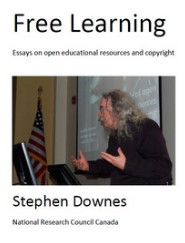


Stephen Downes

Knowledge, Learning, Community

Please select a newsletter and enter your email to subscribe.

Stephen Downes spent 25 years as an expert researcher at the National Research Council of Canada, specializing in new instructional media and personal learning technology. With degrees in Philosophy and a background in journalism and media, he is one of the originators of the first Massive Open Online Course, has published frequently about online and networked learning, and is the author of the widely read e-learning newsletter OLDaily. He is a popular keynote speaker and has presented at conferences around the world. [More]

Support OLDaily

OLDaily has been free and open to all readers since 2001. It is a valuable and widely-used resource for educators, researchers, and learners worldwide. Please consider a monthly contribution to sustain the time and resources required to publish it every day.


Here's what's in the latest edition of OLDaily

How we’ll fight the platform war against Big AI - Anil Dash
79449 image icon

The only reason why there's even such a thing as a 'platform war' against AI is that the companies pushing AI are already, for the most part, platforms. Microsoft. Google. X/Twitter. The reason there's even a need for a war has nothing to do with AI in particular, it's because we've for the most part caved to the big platforms already. Anyhow. Anil Dash offers a few suggestions. First, get in front of it by using "open tools or interfaces that aren't controlled by the Big AI companies" to access AI services. Keep hold of the ability to "seamlessly switch between different AI providers on the fly." Where you can, use Non-commercial LLMs. And on a less useful note, he recommends getting angry.

Today: Total: Anil Dash, 2026/06/25 [Direct Link]


Does this help someone learn?
79448 image icon

When someone says the question should be, "does this help someone learn?" my response is usually to ask, "what do you mean by that?" Part of that is the philosopher in me, but the rest of it is a concern they're focused on teaching to specific outcomes or teaching to the test, neither of which really has the interests of the learner in mind. David Hopkins doesn't exactly take that path, but he is very concerned to make us aware that learning isn't always fun and that design should not increase cognitive effort. Standard instructivist stuff. It's as though learning is a search problem: "They find what they need, understand it and move forward with confidence." I appreciate the desire to get the message across. But that's not 'learning' in any meaningful sense.

Today: Total: David Hopkins, David Hopkins / Education & Leadership, 2026/06/25 [Direct Link]
What Edtech Got Right, What It Missed, and What AI Changes Now (Jennifer Carolan, Reach Capital)
79447 image icon

"The narrative of our field is very much a before-and-after Gen AI story." That's how this article starts, and how it's framed - though the interviewee, Reach Capital's Jennifer Carolan, is very firmly fixed on the traditional classroom environment. "I'd tell every edtech builder to become a substitute teacher. Shadow a teacher. Sit in a classroom for three days in a row—spoiler: it's boring and exhausting, and it isn't the teacher's fault, but the factory-like structure of it all." I don't think that ed tech ill succeed by solving the problems faces in the current classroom environment. Students - just like the startup founders being coached by Reach - should get out of the building. That's why the field isn't a before-and-after GenAI story. Not so long as the AI is intended to emulate a teacher

Today: Total: Allison Dulin Salisbury, The Humanist, 2026/06/25 [Direct Link]
Paradoxes of Openness: Power, Reciprocity, and the Governance of Scholarly Infrastructures
79446 image icon

This is a chapter from a larger book, the whole of which is worth looking at. This summary doesn't do this complex chapter justice. The first paradox is power: "The central issue is no longer only access to scholarly outputs, but who controls the infrastructures through which scholarly communication is organised." This is why I have historically argued for decentralized open access, rather than platform centrlization. The second paradox is 'reciprocity', where proponents of openness have opposed text and data mining (TDM) because " the same openness that dismantled subscription barriers also created conditions under which scholarly content could be recomposed as a scalable input for platform economies" (readers should remember my many years of advocacy for a non-commercial clause to prevent just this). The third is governance: "smaller data infrastructures now find themselves overwhelmed by automated scraping requests, forced to absorb the operational costs of large-scale harvesting while lacking the resources to govern, limit, or benefit from such use." This is why (and my colleagues from EDUCAUSE three decades ago may remember) why I argues for distributed resources and aggregation, rather than federation.

Today: Total: Katja Mayer, The Politics of Open Infrastructures, Open Book Publishers, 2026/06/25 [Direct Link]
LLMs and performative productivity
79445 image icon

It's as though people believe there's a learning 'off switch' (though it only exists in other people). Like this: "A junior who made a mistake is one step closer to being a senior; a junior who let an LLM make a mistake (and had the LLM fix it for them) has probably learned nothing." What would justify this conclusion, authored by John Collinsworth (Nielsen doesn't link to it, though he quotes it extensively - boo, hiss)? The junior will still learn, but will learn a different thing. Nobody 'learns nothing' - human brains don't shut off like light bulbs. What's really happening here is that we're mking a value judgement, specifically, that the lesson learned from doing it by hand is more important than the lesson learned by doing it with AI. This 

Today: Total: Jim Nielsen's Notes, Jim Nielsen's Notes, 2026/06/24 [Direct Link]
Sublimation
79444 image icon

The first think I thought of when I read this post from Julian Stodd was simulated annealing and Boltzmann machines. Why? Because Stodd describes crystals as structures that "represent the lowest energy configuration," which is what Boltzmann machines try to do with neural nets. Stodd compares crystals to organizations, and here the metaphor needs rescuing a bit. He writes, organizations "build structure for greatest efficiency, value, predictability, replicability, and of course, ease of control, and potential for oversight and measurement," but that they are "systems trapped at one energy level, dreaming of the next." Sure, they can change state - they can melt into fluid and merge with something else, or they can sublimate into their individual atomic components (a.k.a. people). But they can change energy level, but (just as with matter and neural nets) they need to go through an annealing process, a 'hardening through fire', as it were. 'Move fast and break things' is a clumsy attempt at just such a process; in neural networks they just increase and decrease the bias (ie., sensitivity, not prejudice (that's a different meaning of 'bias')) of individual entities.

Today: Total: Julian Stodd, Julian Stodd's Learning Blog, 2026/06/24 [Direct Link]

Stephen Downes Stephen Downes, Casselman, Canada
stephen@downes.ca

Copyright 2026
Last Updated: Jun 24, 2026 11:37 p.m.

Canadian Flag Creative Commons License.