Can you ever really think what someone else is thinking?
Víctor Verdejo,
Psyche,
2026/10/23

I think of this often in the sense that I wonder whether people around me can know or understand what I'm thinking about. My conclusion is that they most certainly cannot. But if we don't share thoughts with each other how can we even communicate? This is a good discussion, and I align (more or less) with Kit Fine's suggestion that "communication is not really a matter of thought identity, but thought coordination. What matters is not the intrinsic properties of two people's thoughts or the extent to which those are the same. What matters is how those thoughts are related. For instance, treating our thoughts as if they are about the same things often suffices for understanding and joint behaviour."
Web: [Direct Link] [This Post][Share]
AI is stealing students’ ability to think critically–Journalism 101 may be an antidote
Sireesha N. Rutter, Jupiter Middle School,
eSchool News,
2026/10/23

I wouldn't say journalism is for everyone - it takes a certain skill to approach a stranger and ask them to give you information, even if you are backed by press credentials. That said, my experience in student journalism meant the world to me and the fact that I have a career at all is a testament to the skills and attitudes it helped me acquire. And that's what's described here: "In our classroom-turned-newsroom, students analyze information, verify facts and consider different viewpoints for every story they publish. They wrestle with ethical dilemmas, use their own judgement and write their own copy. " There's one big difference, though. My journalism experience was voluntary, not part of a course or class, and not something managed by a teacher or professor. We - the students - ran the newspaper ourselves. This included not only writing and reporting, but layout and design, advertising, financial management, even office supplies and printing contracts. It makes a difference.
Web: [Direct Link] [This Post][Share]
What Will It Look Like If Investment in Learner Wallets Pays Off?
Mason Pashia,
Getting Smart,
2026/10/23
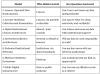
This post introduces us to something called LearnKit. The white paper describes it as follows: "LearnKit is a learner-centered data infrastructure designed to give individuals access to, control over, and the ability to act on their own learning data across K-12, postsecondary education, and the workforce." The work is credited to a Gates Foundation initiative authored by Karen Cator, Valerie Greenhill, and Sharon Leu, but I can't find that anywhere online. The white paper is very high level (by contrast I've spent all days in the weeds looking at digital signing, authentication and decentralized identity protocols, including the W3C's verified credentials data model (hey, we each pick our own interests in our retirement)).
Web: [Direct Link] [This Post][Share]
The Wrong Ban: The Heritage Committee Backed a Targeted Ad Ban for Kids and Stopped Short of a Social Media Ban, Yet the Government Chose the Reverse
Michael Geist,
2026/10/23

Michael Geist writes of a federal committee that "considered two potential bans, one on targeted ads for kids and the other on underage access to social media. The committee recommended the ad ban and stopped short of the social media one, but the government reversed the approach, declining the ad ban while legislating the social media ban for under-16s." I would also favour an ad ban, but it's tricky. There isn't really a difference in principle between an ad directed at kids, and the manipulation of an algorithm to direct certain sorts of messages to kids. Advertising doesn't have to be (and often isn't) simply "buy this" or "you need that". A lot of it is aimed at self-image, perceptions, lifestyles and choices. The way an online gambling company, say, might want to normalize betting on sports.
Web: [Direct Link] [This Post][Share]
What is Experiential Learning?
Clark Aldrich,
2026/10/23
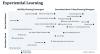
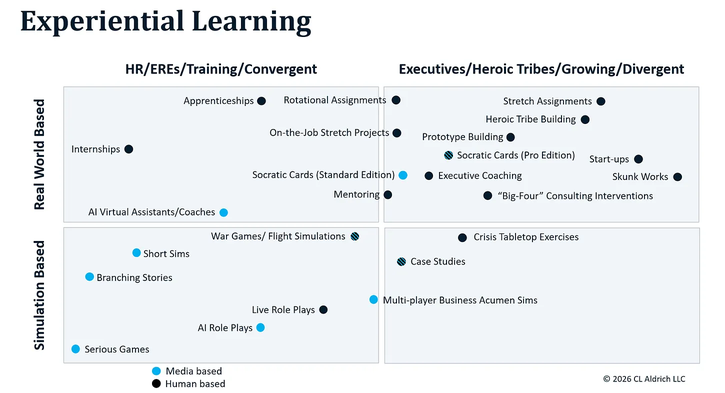
This is just a preview of a concept for an upcoming article, and normally I would just wait for it, but I think this 'experiental learning map' is worth sharing, even though it's still in draft form (illustrated). I probably wouldn't place specific products (especially 'pro editions') intop a map like this. And I think that the range of experiental learning is a lot more broad than the obvious workplace focus informing this current version. The two axes makes some sense - the 'human vs simulation' on the y axis is clear, though the 'training vs growing' needs some sharpening. Terms like 'executive' and 'heroic tribes' don't really belong on axes names. Maybe something like 'predefined vs chaotic' might better reflect the range. Still, I think this is a good time to be thinking about what experiential learning looks like and how we can describe what we're bulding.
Web: [Direct Link] [This Post][Share]
Too simplistic and problematic: a decolonial critique of the North–South binary in international higher education
Samia Chasi, Savo Heleta,
Globalisation, Societies and Education,
2026/10/23

This article criticizes the depiction of the world in terms of a global North and South as too simplistic. "While it is well documented that European colonialism, Euro-American neo-colonialism and coloniality have created and continue to maintain structural global inequalities and inequities across the globe, the world cannot be seen, at least not anymore, only through the lens of Northern wealth and Southern poverty." The authors don't recommend a specific alternative framing, but they do suggest "two possible gestures" instead: "understanding identities of humans as dynamic and fluid rather than fixed and stagnant aligns with the understanding of the North and South as complex, nuanced and changing categories," and "the 'idea of a global subaltern' that transcends the North–South binary and works towards the creation of a more just world for all."
Web: [Direct Link] [This Post][Share]
There are many ways to read OLDaily; pick whatever works best for you:
- Read in your web browser on this web page, updated weekdays
- Receive a daily or weekly email newsletter by subscribing here
- Subscribe to the RSS feed using your favourite feed reader
- Follow @OLDaily@mastodon.social on Mastodon or elsewhere in the fediverse
- Follow @OLDaily on Bluesky
- Read OLDaily as a LinkedIn Newsletter
- Integrate the open API using the JSON feed
This newsletter is sent only at the request of subscribers. If you would like to unsubscribe, Click here.
Know a friend who might enjoy this newsletter? Feel free to forward OLDaily to your colleagues. If you received this issue from a friend and would like a free subscription of your own, you can join our mailing list. Click here to subscribe.
Copyright 2026 Stephen Downes Contact: stephen@downes.ca
This work is licensed under a Creative Commons License.