A new prayer for the fruit fly connectome
Matt Webb,
Interconnected,
2026/09/29

Matt Webb is feeling some qualms about the way the fruit fly connectome (ie., the full map of neurons and the connections between them) of the fruit fly is being used for fun and games on the internet. "Do I imagine that the simulated fruit fly is someone being trapped and tormented, again and again and again, in a software prison? No, the fruit fly connectome is unlikely to be sentient. (But) at some point on the scale, sentience starts to be meaningful." Future AI might be based on a kernel of very real connections and weights, something that - perhaps - requires our ethical consideration. Suppose you copied your cat's connectome to create an AI. Suppose you copied your nephew's. Your own.
Web: [Direct Link] [This Post][Share]
5 Takeaways From Microsoft’s Global AI in Education Survey
Sarah, Alex Sarlin, Ben Kornell, Jen Lapaz,
Edtech Insiders,
2026/09/29
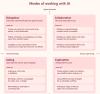
This post summarizes a new report from Microsoft on AI and Education based on a survey of a few thousand students from selected countries. The report is behind a spamwall but this direct link to the 33 page PDF might work. The summary follows a standard order of presentation - people are using AI, think learning is important, are concerned about some issues in common, and are cautious about the future. There's a section on internationalization (takeaway 3) that relies more on an earlier Ipsos report. My takeaways are a bit different - first, how confident leadership is in its own understanding and how different its perception of AI is from the rest, and second, the table of modes of working with AI: Asking, Delegation, Collaboration, Exploration.
Web: [Direct Link] [This Post][Share]
Pressing Prompts: An OER for AI in Higher Education
Stefanie Panke,
AACE,
2026/09/29

According to this article, "Pressing Prompts is an open collection of teaching activities and resources designed to help higher education instructors engage students in discussions about the social and ethical implications of artificial intelligence." It's divided into topics such as 'Can we trust AI?' and 'Is AI biased?' and doesn't try to answer these questions so much as to structure activities and resources to support student discovery around them.
Web: [Direct Link] [This Post][Share]
Clocks and Watches with AI
Dan McCreary,
2026/09/29

Here we have what I think is a great example of a course where it doesn't matter whether you're using AI. It's based on building your own clocks with microelectronics, and as such, hands-on in a way the AI cannot substitute (not, at least, until we get very capable robots). An advantage of this course it that it depends on stock low-cost components easily shipped to your home from the internet. "For under $15 in parts — a Raspberry Pi Pico 2 W, a 2.1" round color display, three buttons, and a breadboard — students build a real, ultra-smart clock from scratch. No soldering required." Via Dan McCreary.
Web: [Direct Link] [This Post][Share]
Finding friction
Tomcw.xyz,
2026/09/29

Tom Watson argues in favour of seeking out productive friction. "The often quoted Thinking and Fast and Slow talks of two types of thinking System 1: fast, intuitive, automatic thinking and System 2: slower, effortful, deliberate thinking. The removal of friction from much of our thinking work means we need to be very deliberate in leaning into System 2 as a practice." My own preference is to use the word 'resistance' rather than 'friction', and in slogan form, it's "Do hard things."
Web: [Direct Link] [This Post][Share]
There are many ways to read OLDaily; pick whatever works best for you:
- Read in your web browser on this web page, updated weekdays
- Receive a daily or weekly email newsletter by subscribing here
- Subscribe to the RSS feed using your favourite feed reader
- Follow @OLDaily@mastodon.social on Mastodon or elsewhere in the fediverse
- Follow @OLDaily on Bluesky
- Read OLDaily as a LinkedIn Newsletter
- Integrate the open API using the JSON feed
This newsletter is sent only at the request of subscribers. If you would like to unsubscribe, Click here.
Know a friend who might enjoy this newsletter? Feel free to forward OLDaily to your colleagues. If you received this issue from a friend and would like a free subscription of your own, you can join our mailing list. Click here to subscribe.
Copyright 2026 Stephen Downes Contact: stephen@downes.ca
This work is licensed under a Creative Commons License.