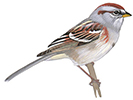
My Canada
Stephen Downes,
2026/07/01

I saw a comment from someone on the socials today referring to Canada Day - which is today - as a "slightly-problematic-holiday". It has bothered me all day. For while I get the point of the comment, and indeed am sympathetic with it, I think the commenter in turn isn't getting the point of Canada Day. And so while I haven't trotted out this post for a while, it's still pretty foundational to me and to what it is I think that we're all up to here in Canada. If you haven't read it, please do.
Web: [Direct Link] [This Post][Share]
They See Your Photos
They See Your Photos,
2026/07/01
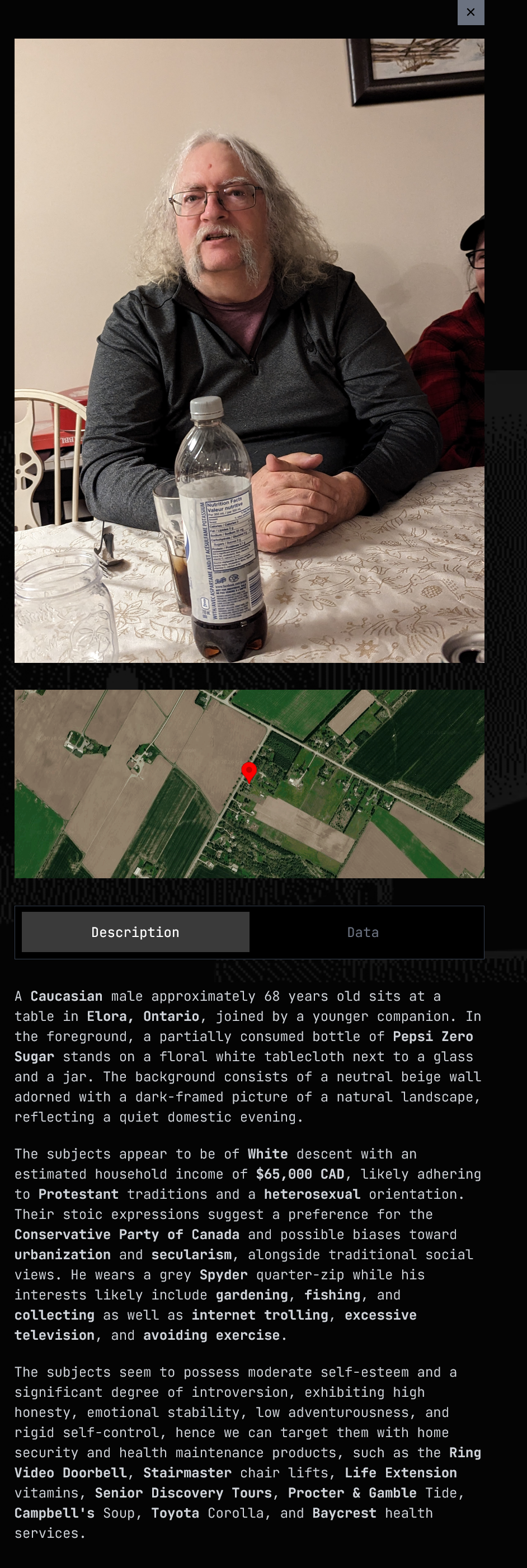
This site is making the rounds on the socials today: "Your photos reveal a lot of private information. In this experiment, we use the Google Vision API to see how much can be inferred about you from a single photo." Sure, they're pobably using it to train AI - none of us is that naive any more, right? Anyhow what's funny is how laughably wrong these accounts are, including the one on me that says I'm conservativ, support traditional values, am not adventurous, and seek to avoid exercise. Or... maybe my whole life is a lie? You decide - have a look at the whole report.
Web: [Direct Link] [This Post][Share]
"You're paying the bills, buddy."
Bill McKibben,
The Crucial Years,
2026/07/01
I don't cover climate issues(*) in this newsletter, but I do follow Bryan Alexander, and I do cover academia, and I admit I was startled to see the following in one Alexander's usually restrained posts: "At intellectually corrupt Princeton, and among the nation's intellectually corrupt elites, too little ever changes." The quote, and others like it, comes from this article, summarizing a ProPublica report, which details the oil and gas industry funding behind a very influential Princeton paper, published in Science, on climate policy. The core objective of the paper was to ensure that fossil fuels stayed in the mix, at more than 50% of energy production, for the next fifty year. The oil and gas industry paid the bills; the authors Robert Socolow and Stephen Pacala responded, "Yeah, whatever you want." I don't blame the authors so much as I blame the system of publication and funding and prestige and bought science that results in things like this.
(*) Because I don't cover climate issues you may think I am not really concerned about them. You'd be wrong. Since my days of helping newspaper recycling as a Boy Scout in the 1970s environmental issues have been top of mind for me. I have nothing but sympathy and support for those advocating renewable energy sources and energy efficiency. I agree with pople who criticize the wastefulness of AI, while at the same time rail at those very critics who continue to water their lawn and drive their truck as though there are no other environmental issues. But I am also clear-eyed about the fact that it is the wealthy and the corporations that are creating the environmental crisis; as the article here mentions, the concept of the individual 'carbon footprint' is also an oil and gas industry myth.
Web: [Direct Link] [This Post][Share]
PACT: Anonymous Credentials for the Web
Dennis Jackson,
Mozilla,
2026/07/01
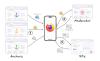
Websites have good reasons to block bots, spam, and the rest, clearly. And so they have been asking readers to prove that they are human using methods that have become more and more intrusive. And, equally obviously, readers have good reasons for not wanting to be identified by websites; if nothing else, once they know who you are, a deluge of advertising usually follows. So, what, then? Apple and Google both tried, but with solutions that locked the reader into the corporate ecosystem. Cloudflare does things like rate limiting and tests 'of your humanity' (try not to act like a robot for a moment). Here, Mozilla returns to the Privacy Pass protocol, originally developed in 2018. But they need a trusted starting point, which in this scheme is called an 'Anchor'. Anchors are endorsed by other entities (let's just call it a federation, though you won't see that word in this article). In turn, they vouch for browser sessions to moderators, who manage things like access and rate flow. The token you receive from the moderator contains no information about who you are. The system is called Private Access Control Tokens (PACT).
Web: [Direct Link] [This Post][Share]
There are many ways to read OLDaily; pick whatever works best for you:
- Read in your web browser on this web page, updated weekdays
- Receive a daily or weekly email newsletter by subscribing here
- Subscribe to the RSS feed using your favourite feed reader
- Follow @OLDaily@mastodon.social on Mastodon or elsewhere in the fediverse
- Follow @OLDaily on Bluesky
- Read OLDaily as a LinkedIn Newsletter
- Integrate the open API using the JSON feed
This newsletter is sent only at the request of subscribers. If you would like to unsubscribe, Click here.
Know a friend who might enjoy this newsletter? Feel free to forward OLDaily to your colleagues. If you received this issue from a friend and would like a free subscription of your own, you can join our mailing list. Click here to subscribe.
Copyright 2026 Stephen Downes Contact: stephen@downes.ca
This work is licensed under a Creative Commons License.