
Rebuilding Shared Meaning in a Fragmented World
Hamish Campbell,
Open Media Network,
2026/06/15
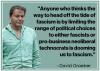
To put it simply, in 'modernism' there was one point of view (one type of truth, one view of the world, one way of describing it), which had its good and bad points. Then came 'post-modernism', which allowed for many points of view. "Instead of thoughtful maps, we had endless competing realities." Now we're in a mess that "leaves us trapped in blinded deadens of certainties of yesterday and the endless fragmentation of today." Now what we're searching for is a way to support 'shared meaning' and 'collective action'. That's the article. Here's my take: there never was just one point of view; there were always multiple points of view, but we just weren't able to see them. Now, the scales have fallen from our eyes, and we see the complexity of perspectives for what it is. Trying to force the entire world into having 'one point of view' is a fool's errand. Forget shared meaning and collective action. Focus on global networks and cooperation. (That's my pitch, and if you like it, you can subscribe to my newsletter).
Web: [Direct Link] [This Post][Share]
The uncontroversial 'thingness' of AI
Lucy Suchman,
2026/06/15

Lucy Suchman writes (5 page PDF), "The term 'AI' can be read as a label for currently dominant computational techniques and technologies that extract statistical correlations (designated as patterns) from large datasets, based on the adjustment of relevant parameters according to either internally or externally generated feedback." Great definition. So how did AI come to be thought of as a 'thing'? "'AI' is a term that suggests a specific referent but works to escape definition in order to maximize its suggestive power... the thingness of AI works through a strategic vagueness that serves the interests of its promoters, as those who are uncertain about its referents (popular media commentators, policy makers and publics) are left to assume that others know what it is." Image: Heaven.
Web: [Direct Link] [This Post][Share]
Statement on the US government directive to suspend access to Fable 5 and Mythos 5
Anthropic,
2026/06/15

My own take is that Anthropic's competitors (one especially that rhymes with 'tusk') have been given a gift by the U.S. government (there are a million other points of view being expressed out there that I won't attempt to review). "The US government, citing national security authorities, has issued an export control directive to suspend all access to Fable 5 and Mythos 5 by any foreign national... The net effect of this order is that we must abruptly disable Fable 5 and Mythos 5 for all our customers to ensure compliance." I tried Fable briefly to run a security scan on my software; it did find a new issue, but also ate my (admittedly meagre) budget quickly.
Web: [Direct Link] [This Post][Share]
What Does It Feel Like to Live Under the Threat of Redundancy?
Glen O'Hara,
Independent Social Research Foundation,
2026/06/15

As a long-time government employee I learned early that there's no such thing as job security, and when I retired in April the entire Human-Computer Interaction (HCI) team was cut, which took the bloom off the rose. I've never understood layoffs; it really is like "chopping off their own arms and legs in a vain attempt to protect the heart." Layoffs seem like recognition that your workload is shrinking, and instead of using all the resources already at your disposal to find a way to expand your services develop new offerings, you just contract to make sure the next quarter is profitable. As this article makes clear, if you thought universities were different, you're wrong. "Our universities have now become hollowed-out and unmoored from their original purpose... they are more like aggressive medium-sized enterprises struggling for market share than the school-like cloisters that voters perhaps picture."
Web: [Direct Link] [This Post][Share]
If everything is a neighbourhood, is anything a neighbourhood?
Tom Watson,
Tomcw.xyz,
2026/06/15

We see the word 'community' a lot in these pages, but how big is a community? We can use Tom Watson's discussion of the term 'neighbourhood' as a proxy for this question. The answer depends on who you ask (though a very informal poll makes it less than 1,000 rather than some larger number). When you ask actual people to define a neighbourhood, "the answers were never about population counts (although the numbers were in the 4k range). People drew lines around a few streets. A park. The shop. The school run. The boundaries were small, personal, and there was nuance and disagreement." Contrast that with a definition that "becomes a unit of administration dressed up as a unit of belonging. A word borrowed to make bureaucracy feel human." What's the test? "Would the people inside the line say it's theirs? If yes, you've defined a neighbourhood. If no, you've defined a delivery area."
Web: [Direct Link] [This Post][Share]
Learning through community service
Julie Leduc,
University Affairs,
2026/06/15

This is a light article, but it speaks to an interest of mine, community service learning (CSL), which "allows students to get involved with community organizations, often on a volunteer basis, and to collaborate with them on projects that meet community needs." As usual, I have critiques around the edges. For example, Sivane Hirsch, a professor of education at ULaval, says, "The idea is to make academic knowledge accessible, not just through scientific articles, but by putting academics to service in the community." I would actually emphasize the other direction, whereby students and academics learn from the community. Additionally, at the University of Ottawa, the program "gives students the option of volunteering around 30 hours of their time to a community organization each semester in lieu of completing a final project." 30 hours is not nothing, but it's too transactional, too temporary and too late.
Web: [Direct Link] [This Post][Share]
From mission to market: a case study and analysis of the commercialisation of institutional publishing
Kevin Sanders, Lucy Barnes, Tom Grady, Kira Hopkins, Anna Hughes,
Scottish Journal of Open Research,
2026/06/15

This article (18 page PDF) is in reaction to the partial sale of Amsterdam University Press (AUP) to Taylor and Francis. "Our criticism of the primacy of commercial interests in academic publishing is not an arbitrary purity test," write the authors. "Academic research within publicly funded universities is (still, for now) a collaborative endeavour that aims to serve societal needs, not a private activity intended to generate profit for a small group." A primary issue is governance, "and the importance of good, participatory governance. In the case of university presses... what their ownership and governance structures are, what their economic models are, and who has a meaningful say in their operations and future direction." Additionally, "It also ties into concerns about 'community-washing' that Copim, among others, has begun to raise (Hopkins et al 2024): commercial companies adopting the rhetoric of non-profit and community-led enterprises as marketing spiel." Image: Open Access Network.
Web: [Direct Link] [This Post][Share]
There are many ways to read OLDaily; pick whatever works best for you:
- Read in your web browser on this web page, updated weekdays
- Receive a daily or weekly email newsletter by subscribing here
- Subscribe to the RSS feed using your favourite feed reader
- Follow @OLDaily@mastodon.social on Mastodon or elsewhere in the fediverse
- Follow @OLDaily on Bluesky
- Read OLDaily as a LinkedIn Newsletter
- Integrate the open API using the JSON feed
This newsletter is sent only at the request of subscribers. If you would like to unsubscribe, Click here.
Know a friend who might enjoy this newsletter? Feel free to forward OLDaily to your colleagues. If you received this issue from a friend and would like a free subscription of your own, you can join our mailing list. Click here to subscribe.
Copyright 2026 Stephen Downes Contact: stephen@downes.ca
This work is licensed under a Creative Commons License.