Pastoral Landscapes Brim with Patterns in Luminous Paintings by David Brian Smith
Kate Mothes,
Colossal,
2025/11/25

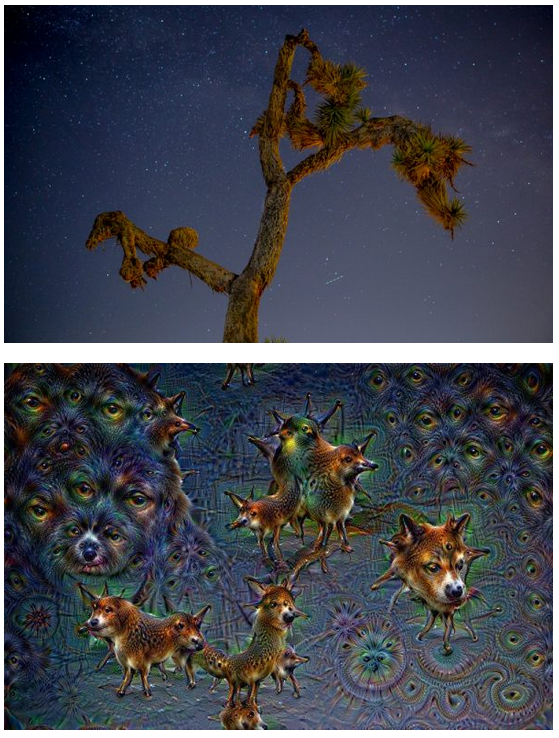
Remember 'dogception'? That was (as illustrated in this post) what resulted when an AI over matched for patterns resembling parts of dogs, thus reinterpreting any impage so it looked like it was filled up with dogs. I get a similar effect when I look at my bedroom ceiling - I 'see' dogs in the sames and patterns of the knots in the pine boards. This articxle describes David Brian Smith's similar sort of effect in pastoral landscapes - not just dogs, but all matter of things. "Within the sky, fields, rivers, and forests, hundreds of little hatch marks, flowers, starbursts, and other thematic motifs dance across the surface." I don't see the world that way (I wish I did) but I can easily understand how someone would, and how it might alter their sense of what things actually are.
Web: [Direct Link] [This Post][Share]
Replicability and the humanities: the problem with universal measures of research quality
Chloe Patton,
Research Evaluation,
2025/11/25

This is an excellent article that speaks to me specifically as someone based in the humanities who does work in the field of education. It argues that replication - using new data to solve the same problem - cannot be applied to the humanities because there is not an independent reality against which the studies can be compared. Rather, "The central ontological assumption at the heart of most research in the humanities is that reality is socially mediated through language." That does not mean that 'anything goes' in humanities research (though it does argue against a formal research methodology). Evaluation of argumentation in the humanities employs "all manner of critical tools employed to strip the flesh from ideas and expose weaknesses in interpretations." Now in my own work I take the concept a bit further: I don't think knowledge need be 'socially mediated', and I think there are many other media over and above language. What then can I usefully say about education? Well, quite a lot, I think. Not replications of perceptions as expressed through Likert scales, nor assessments of 'what works' in education, but rather, ways of looking at the means, motivations and assumptions that lie in the implementations - or rejections - of educational technology. Image: UQueensland.
Web: [Direct Link] [This Post][Share]
Exploring Joplin Note-Taking Tool
Miguel Guhlin,
Another Think Coming,
2025/11/25
Miguel Guhlin reviews Joplin Notes, a new online note taking application that can be run locally or in the cloud. It's one of a class of tools designed to organize your writing when you write a lot of content. The main right-up-front feature is easy conversion from markdown to HTML.
Web: [Direct Link] [This Post][Share]
Anatomy of an AI agent knowledge base
Bill Doerrfeld,
Infoworld,
2025/11/25

This is a useful article in that it fulfills its stated purpose: it gives the reader a good description of what a knowledge base looks like and how each element is used to make the AI that uses it more responsive and accurate. But what struck me as I read it is that it offers a good analogy to a human's knowledge base - there is the set of guides, conventions and rules that "mirrors what you';d find in a senior employee's mental toolkit." There's the data in a database. There are policy and procedure manuals. And then there is the semi-structured knowledge equivalent to a knowledge wiki or even a personal library. Each person's knowledge base is unique, and each has their own 'data moat' - the distinctive knowledge that gives them value in the workplace. Via Miguel Guhlin.
Web: [Direct Link] [This Post][Share]
There are many ways to read OLDaily; pick whatever works best for you:
- Read in your web browser on this web page, updated weekdays
- Receive a daily or weekly email newsletter by subscribing here
- Subscribe to the RSS feed using your favourite feed reader
- Follow @OLDaily@mastodon.social on Mastodon or elsewhere in the fediverse
- Follow @OLDaily on Bluesky
- Read OLDaily as a LinkedIn Newsletter
- Integrate the open API using the JSON feed
This newsletter is sent only at the request of subscribers. If you would like to unsubscribe, Click here.
Know a friend who might enjoy this newsletter? Feel free to forward OLDaily to your colleagues. If you received this issue from a friend and would like a free subscription of your own, you can join our mailing list. Click here to subscribe.
Copyright 2025 Stephen Downes Contact: stephen@downes.ca
This work is licensed under a Creative Commons License.