Learning and memory in molecular networks
Thomas Lissek,
2025/07/01
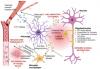
Today's newsletter tells a story, from start to finish. It's not a simple story, it's a long and complex story, and many parts are missing, but I'm hoping readers will see the thread here... This article (17 page PDF) argues for an interpretation of memory such that every part of a human - every molecule - records a memory. "Molecular memory formation is proposed as a universal concept to explain adaptive organism phenotypes and can elucidate memory phenomena in the brain, immune system, skeletal muscle, skin, endocrine system and during development among others." This challenges our (traditional) ideas of what it means to learn, what part of learning is 'natural', and the relation between who we are and how we function as a society. Image: Guilherme, et al. Via Matthias Melcher.
Web: [Direct Link] [This Post][Share]
Engram (neuropsychology)
Wikipedia,
2025/07/01
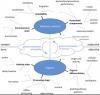
"An engram is a unit of cognitive information imprinted in a physical substance, theorized to be the means by which memories are stored as biophysical or biochemical changes in the brain or other biological tissue, in response to external stimuli." From where I sit, the engram is a purely theoretical unit and unnecessary in any account of learning (and hence, learning technology), but there is a sense to be made here if the idea of specific physical configurations responding to (or 'recognizing') specific physical input. The concept of the engram is supposed to stand for the semantic content this capacity to recognize represents. What's interesting is that engrams of simple conditioning are associated with specific physical regions of the brain (such as the lateral interpositus nucleus (LIP)) while more complex representations are largely distributed in the brain. So - simple conditioning appears 'natural' while complex representations appear 'learned'. Image: Science Direct.
Web: [Direct Link] [This Post][Share]
Capitalism Needs Champions
Matthew Hennessey,
Wall Street Journal,
2025/07/01

This article asserts that dog-eat-dog capitalism is "natural" and complains "each generation somehow produces naïfs who are certain that collectivism is the true longing of the human heart... This is a failure of education, yes. Basic economics is rarely taught in high school or required in college. But it's equally a failure of public relations. Who is making a sustained and coherent public case for American-style capitalism?" If I had to judge based on what's out there, it's crypto scams and casinos. But Matthew Hennessey argues, "Socialism is incompatible with human nature. People are driven to build, to invest, to strive and be productive, to pursue their own families well-being above all. Socialism subverts these impulses." Most WSJ content is hidden behind a paywall; this for some reason isn't, but just in case, here's an archive version. Via Jeff Jarvis.
Web: [Direct Link] [This Post][Share]
Trump, Musk, Republicans, and the Empathy Bug
Robert Reich,
2025/07/01

What is natural for a human being? I think a lot of people would count empathy as natural. This article recounts an effort to teach it out of people. "Elon Musk revealed the core of the ideology animating the richest person in the world. 'The fundamental weakness of Western civilization is empathy,' Musk said, adding that liberals and progressives are 'exploiting a bug in Western civilization, which is the empathy response.'" Whether or not it is natural, it is arguable that "Empathy is a necessary precondition for a society. Without empathy, we'd be living in a social Darwinist jungle animated only by selfish individuals pursuing selfish needs."
Web: [Direct Link] [This Post][Share]
OEG Voices 084: Board Viewpoints with Takaya Yamazato
Alan Levine,
OE Global Voices,
2025/07/01

This is a link to a podcast interview with Takaya Yamazato, who joined the OEGlobal Board of Directors in 2024. I'm linking to it mostly for this quote referenced on the web page: "The education that a person needs now is to grow people who are able to do the right thing. We must grow people who are not just for efficiency, profit, or national gain, but also for the good of the world." I mean, sure, but whose decision is that to make? What counts as the right thing? How does that benefit the learner? There are many things - empathy, critical thinking - that matter, but don't place people (necessarily) onto a specific track. Let's not decide for them; let's give them the tools to decide.
Web: [Direct Link] [This Post][Share]
The Death of Critical Thinking Will Kill Us Long Before AI.
Joan Westenberg,
Westenberg.,
2025/07/01

Miguel Guhlin references this article, musing that "I feel they should be shorter. Evidence, perhaps, of what this article asserts: '...the death of critical reading harms the sentient minds of billions.'" I personally think that critical thinking has never really entered the mainstream; it has mostly never been taught in schools, and most 'media literacy' programs died from lack of consistent funding. Even this article represents a confusion between 'critical reading' and 'remembering' and even 'comprehending'. "Too many of us have lost - or are losing - the focus and patience for lengthy, complex texts." As a society we have a very short memory, forgetting that a higher education - and anything resembling critical thinking - was until only a few decades ago the preserve of the private school set.
Web: [Direct Link] [This Post][Share]
An "Indie Rock Band" That Appears to Be Entirely AI-Generated Is Making Alarming Amounts of Money on Spotify
Futurism,
2025/07/01

So I listened to The Velvet Sundown on YouTube and it frankly was no better but no worse than the generic faintly country-pop pablum the studios have been churning out for decades. From my perspective, it makes no difference to me whether it is human or AI controlled. I don't care who makes money on Spotify. What I think we need to be watching for is when the emotional power of music is unleashed. Could we ever get an AI-powered Woody Guthrie or Neil Young? Or even an AI Marseillaise?
Web: [Direct Link] [This Post][Share]
There are many ways to read OLDaily; pick whatever works best for you:
- Read in your web browser on this web page, updated weekdays
- Receive a daily or weekly email newsletter by subscribing here
- Subscribe to the RSS feed using your favourite feed reader
- Follow @OLDaily@mastodon.social on Mastodon or elsewhere in the fediverse
- Follow @OLDaily on Twitter
- Integrate the open API using the JSON feed
This newsletter is sent only at the request of subscribers. If you would like to unsubscribe, Click here.
Know a friend who might enjoy this newsletter? Feel free to forward OLDaily to your colleagues. If you received this issue from a friend and would like a free subscription of your own, you can join our mailing list. Click here to subscribe.
Copyright 2025 Stephen Downes Contact: stephen@downes.ca
This work is licensed under a Creative Commons License.