Students these days
Ellen Clarke,
philosomama,
2025/04/23

Ellen Clarke references Steven Hales' "thought-provoking post about ... his students becoming significantly worse at reading, writing and basic maths over the course of his 30-year career. And he puts it down largely to smart-phone addiction." Though, as Clarke notes, students who "come out of a school system in which teachers are tasked with giving them a curriculum - a nationwide sort of bible of truths - and helping them to ingest it as accurately as possible so they can pass exams." But sure. It's the phones that are the problem.
Web: [Direct Link] [This Post][Share]
Google won't ditch third-party cookies in Chrome after all
Ryan Whitwam,
Ars Technica,
2025/04/23

Google is abandoning its 'privacy sandbox' initiative. What this means is that its flagship browser, Chrome, will continue to support tracking cookies. There's some reassuring text on the website to say that the initiative will continue, but with no real objective to achieve, it won't. Combined with recent changes to Chrome to disable adblockers, it really looks like Google is essentially commiting to a vision of the web as (primarily) an advertising medium. Remember, everyone, advertising is the original fake news. It is the original disinformation. Advertising, not social media, is what is undermining democracy. See also: the Register, the Verge, Digiday, Thurrott, Tech Radar, Computerworld. Related: here come the ads in Meta's Threads. Also realted: US Wants Judge to Break Up Google, Force Sale of Chrome.
Web: [Direct Link] [This Post][Share]
Why AI will not Democratize Education: a Critical Pragmatist Perspective
Michał Wieczorek,
Philosophy & Technology,
2025/04/23

This is quite a good article that explores a topic close to me. One core question I have is: when we say 'democratizing education' do we mean the same thing Dewey means? Michał Wieczorek makes a pretty good case, identifying four key tenets of Dewey's position (quoted): children learn about and negotiate the meaning of democracy; the skills, knowledge and dispositions necessary to participate in democratic processes; experience in democratic living and thinking together; and extending equally to all members of the democratic community. The other core question is: does AI education look like what Wieczorek describes? Here the case is not as strong, as the focus is on intelligent tutoring systems, "an extrapolation of the trends in educational technology dating back to Skinner's teaching machines." Wieczorek argues that "AI's focus on the mastery of curriculum might help students learn about democracy, but democratic education cannot be reduced to passive absorption of wisdom." Also, "mastery-based methods and objectives embedded in ITS are much less flexible and student-focused than participatory learning approaches... ossifying schools as places where knowledge is passed down hierarchically rather than co-created in a horizontal, participatory manner." All true, but these are arguments for a different direction in AI native education, not an argument against it altogether.
Web: [Direct Link] [This Post][Share]
AI native search Explained
Nir Diamant,
DiamantAI,
2025/04/23

I remember when Google search was really useful. It was a time when the search engine learned about me and the sort of thing I clicked on, and so it felt almost like a personal search, giving me results tailored to my specific needs. Those days are long gone, of course, the victim of relentless advertising. Now we're getting 'AI native search' and the question is: will it mean really useful search again, or even more relentless advertising. This article, which describes how native AI search will work, equivocates on the question (to be fair, answering it was not the author's intent) but from the feel I get on reading it, the biggest problem we will have with AI native search will be, once again, relentless advertising. "The new goal becomes getting your brand mentioned within the AI's answers, rather than just earning clicks." And the reader will never know whether it was paid placement or genuinely good information.
Web: [Direct Link] [This Post][Share]
An evaluation of Contact North's AI tools for education
Tony Bates,
Online learning and distance education resources,
2025/04/23
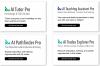
This is so smart on so many levels. Here's the LinkedIn post from Tony Bates: "Contact North has made available four AI tools for students and faculty. I will be evaluating these over the next few weeks at htttps://tonybates.ca, but before I do that, I'd like your views on the evaluation framework I have created. How could I improve this?" The tools, available in English or French, are 100% free, and include AI assistants for tutoring and teaching as well as guides to learning and career opportunities generally and in the trades. The evaluation framework is by-the-book as it gets, assigning points for target group, ease of use, accuracy and comprehensiveness, learning outcomes and transparency. Related: Contact North's Snapshots for Teaching With AI.
Web: [Direct Link] [This Post][Share]
News Alchemists #16
News Alchemists,
2025/04/23

This is the 10th email edition of this newsletter. The previous six were on LinkedIn, which really creates distribution issues if that's the only place you share. And that's why I'm linking to the newsletter, instead of to the LinkedIn essay that it cites, because the article is locked behind the LinkedIn spamwall. This, specifically, is what I want to share here: "I think the greatest human need is feeling connected to the people around us, without which we get suspicion and polarisation. And I think there is a very healthy future for journalists and media companies that can provide it." That's probably true, and it's probably true of educational organizations as well. The knowledge we get from these institutions is only useful to the extent it connects us; it is skill and facility in building these connections that is really what is on offer at learning institutions.
Web: [Direct Link] [This Post][Share]
There are many ways to read OLDaily; pick whatever works best for you:
- Read in your web browser on this web page, updated weekdays
- Receive a daily or weekly email newsletter by subscribing here
- Subscribe to the RSS feed using your favourite feed reader
- Follow @OLDaily@mastodon.social on Mastodon or elsewhere in the fediverse
- Follow @OLDaily on Twitter
- Integrate the open API using the JSON feed
This newsletter is sent only at the request of subscribers. If you would like to unsubscribe, Click here.
Know a friend who might enjoy this newsletter? Feel free to forward OLDaily to your colleagues. If you received this issue from a friend and would like a free subscription of your own, you can join our mailing list. Click here to subscribe.
Copyright 2025 Stephen Downes Contact: stephen@downes.ca
This work is licensed under a Creative Commons License.